The moment a crisis hits, contact centers reveal their limits. Storms ground flights, payment gateways fail, or a product outage floods every channel at once. Static IVR menus and skills lists were never designed for this level of complexity or urgency. AI call routing changes the game by listening first, understanding context, then orchestrating the best next step in real time.
For CX leaders and digital transformation teams, this is not just a technology upgrade. It is a new way to align customer need, operational capacity, and business policy, so that every call, chat, or message finds the fastest, fairest, and most efficient path to resolution.

The CX Leader’s AI Implementation Playbook
The CX Leader’s AI Implementation Playbook is your step-by-step guide to navigating the AI revolution in customer experience. With practical frameworks, industry spotlights, and proven strategies, it gives you the roadmap to build the business case, design credible pilots, scale responsibly, and deliver measurable ROI in the next 100 days and beyond.
Why legacy routing falls short
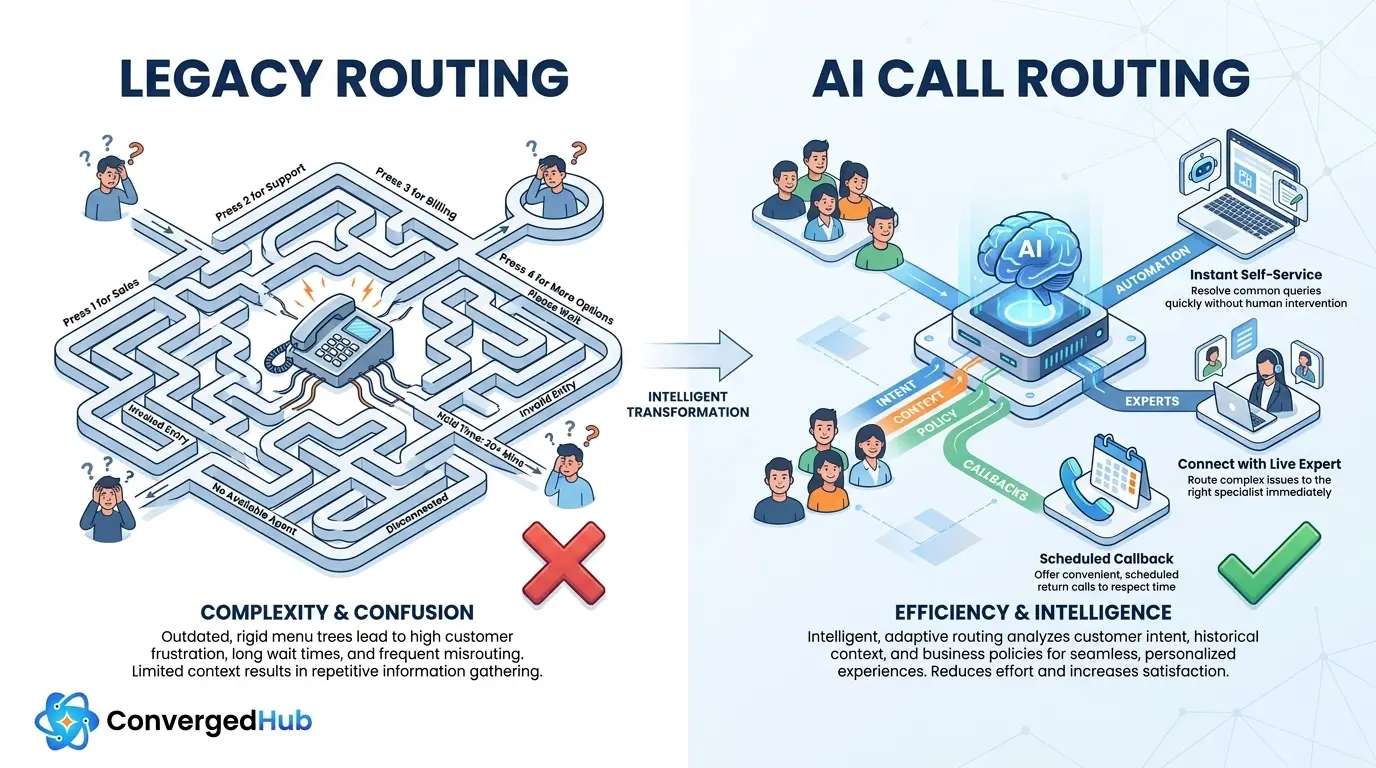
Most routing strategies in place today are descendants of legacy IVR trees. They rely on a limited set of keypad choices, hard coded skills, and queues that assume customers neatly fit into a few predefined categories. Real life does not cooperate.
One caller is stranded at an airport needing same day rebooking. Another is casually checking a loyalty balance. A third is reporting suspected fraud. Traditional menus cannot reliably differentiate between them, so they wait in the same queue or bounce between agents until someone with the right expertise and authority finally picks up.
This older model creates several problems for modern enterprises:
- High customer effort: Long menus, repeated explanations, and misroutes drive abandonment and complaints.
- Operational waste: Agents spend precious time transferring, re authenticating, and re qualifying issues instead of resolving them.
- No real time adaptability: During incidents or promotions, leaders must scramble to reconfigure queues and staffing manually.
- Limited personalization: Tier, lifetime value, sentiment, and journey history rarely influence routing decisions in a meaningful way.
Digital first customers expect more. They assume every brand can recognize them, understand why they are reaching out, and respond with the same intelligence they see in consumer apps. AI call routing is how CX and innovation leaders close that gap, without ripping out existing investments overnight.
Defining AI call routing
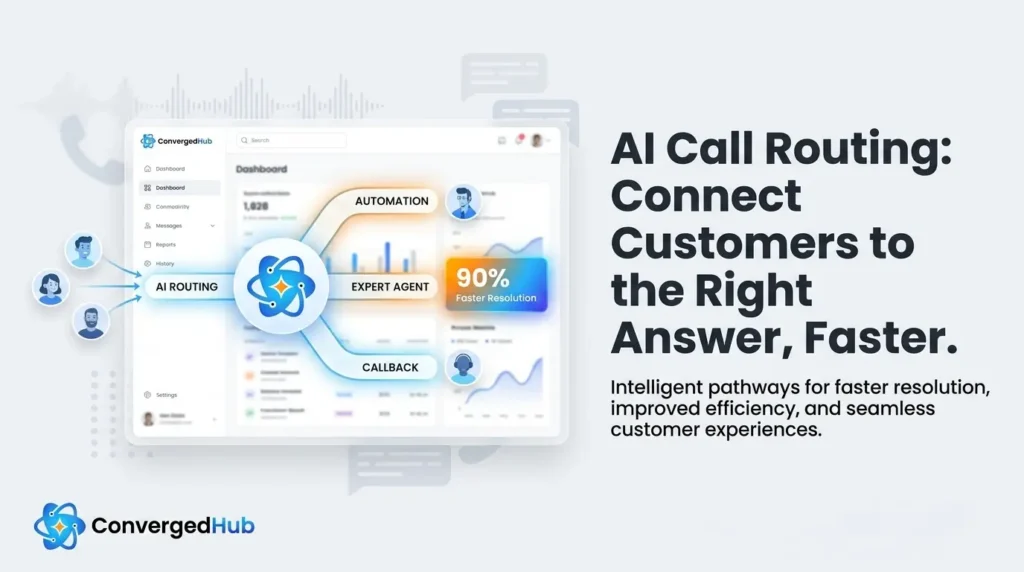
AI call routing uses natural language understanding, real time context, and business rules to determine the most effective resolution path for every interaction. Instead of forcing customers through rigid menus, it asks open questions such as How can I help you today and actually understands the answer.
Behind the scenes, the routing brain interprets the customer request, evaluates urgency and complexity, consults relevant data sources, and then chooses a path that could include:
- Automated self service: Handling clear, well defined intents such as balance checks, simple order changes, or password resets via conversational bots.
- Targeted human support: Directing calls to specific agents, micro queues, or pods that have the best skills, permissions, and context to resolve the issue.
- Smart callbacks or channel shifts: Offering scheduled callbacks, digital follow ups, or a converged experience that blends live voice with visual flows on web or mobile.
Crucially, AI call routing is not a one time configuration. It learns from outcomes and conversational analytics. Over time, it recognizes which intents are safe to automate, where escalations occur, and how routing choices affect metrics such as first contact resolution and customer effort.
For leaders designing modern experiences, that means routing is no longer a static wiring diagram. It becomes a living system that improves as your customers and business evolve.
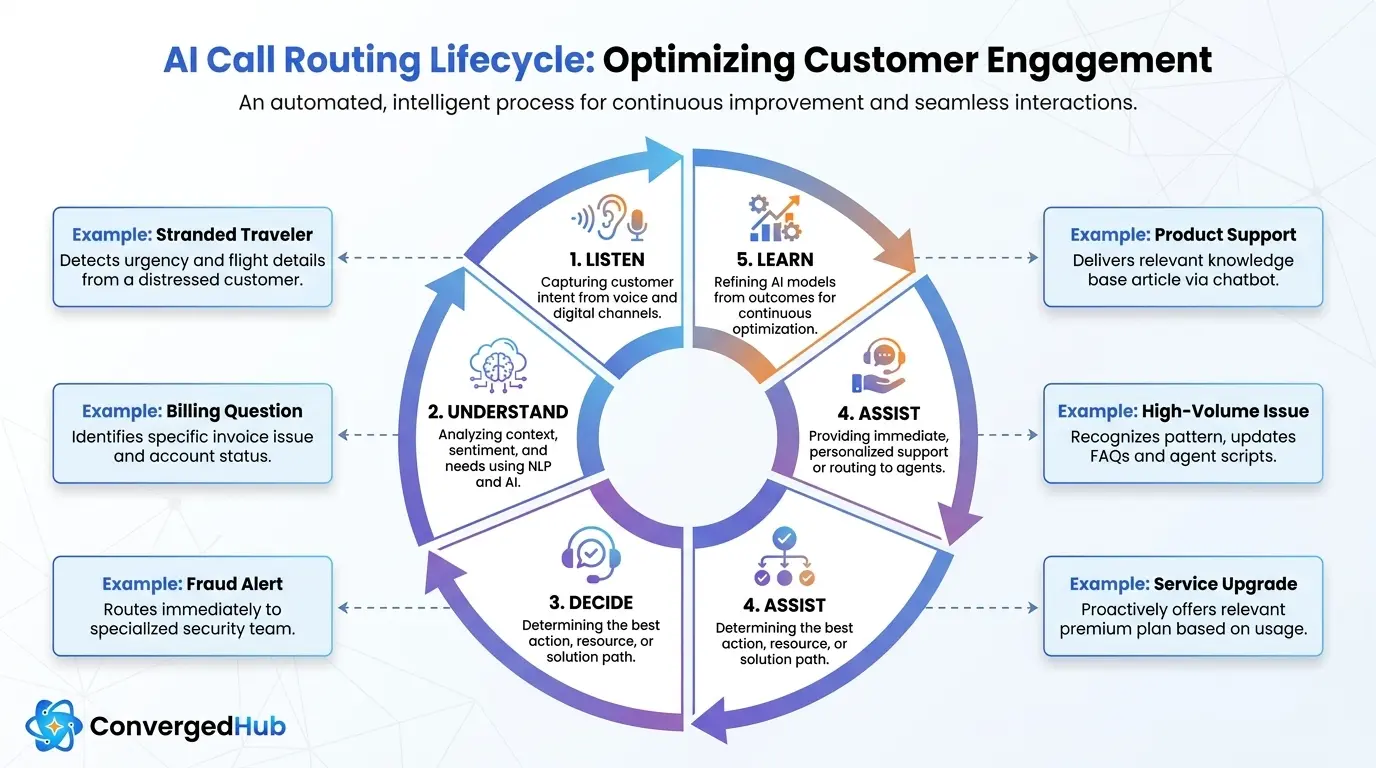
Inside the AI routing engine
Under the hood, AI call routing combines multiple capabilities into a single decisioning layer. Understanding these components helps CX and transformation leaders design better journeys and evaluate vendors more effectively.
1. Intent and context capture
The experience starts by listening. Using speech recognition and natural language processing, the system extracts intent, key entities such as order numbers or product names, and sentiment from what the customer says or types. It also pulls context from CRM, order systems, prior interactions, and any IVR selections.
Instead of assuming that everyone who says billing belongs in one bucket, the router can distinguish between pay my bill, dispute a late fee, or update my corporate payment method, each of which may follow a very different path.
2. Policy and priority scoring
Next, the engine applies business logic. It checks customer tier, open cases, entitlements, regulatory constraints, and service level agreements. It evaluates urgency and complexity, for example, treating a stranded traveler or a suspected fraud report as higher priority than a routine address update.
This policy layer ensures that AI call routing aligns with how your organization actually wants to serve different segments, geographies, and scenarios, not just what is technically possible.
3. Decisioning and path selection
With intent and policy in hand, the system chooses the best next step. Options can include:
- Resolving the issue in fully automated self service.
- Routing to a specialized queue, pod, or individual expert.
- Offering a callback window instead of placing the customer on hold.
- Switching to a lower effort channel such as chat or messaging.
- Providing a converged experience by sending a secure link during a live call so the customer can upload documents, complete a form, or review a summary visually while still talking.
4. Real time support during handling
When the interaction reaches an agent, AI does not step aside. A contact center copilot can surface relevant knowledge base articles, previous case summaries, and recommended next best actions. It can auto populate summaries and after call notes, reducing handle time and cognitive load.
When the interaction stays in automation, the same intelligence powers dynamic dialog, knowledge search, and seamless handoff when confidence drops or the customer requests a human.
5. Continuous learning loop
Finally, every interaction feeds a learning loop. Leaders can analyze deflection and containment rates by intent, see where escalations happen, and review why customers abandon. These insights drive improvements in both self service design and routing logic.
Top platforms support experimentation and A B testing so teams can iterate safely. For innovation leaders, this means AI call routing becomes a disciplined experimentation engine, not a black box.
Beyond skills based routing
Skills based routing was a major step forward when it replaced simple round robin models. But in a world of digital journeys and volatile demand, it is no longer enough on its own. Comparing it side by side with AI call routing clarifies why.
- Inputs: Traditional skills routing depends on dialed numbers and menu choices. AI call routing uses real time intent, language, sentiment, and customer data to drive decisions.
- Granularity: Skills routing groups requests into broad buckets such as billing or technical support. AI call routing can differentiate fine grained intents such as dispute late fee versus request invoice copy or reset multifactor token.
- Adaptability: Skills configurations often require manual updates during incidents or campaigns. AI call routing can automatically rebalance based on volume, capacity, and policy changes.
- Experience: Skills routing typically means longer menus, more transfers, and repeated authentication. AI call routing aims to minimize steps and handoffs, which reduces customer effort and increases first contact resolution.
Importantly, this is not an either or choice. Many enterprises layer AI call routing on top of existing skills structures. The AI understands the customer intent and context, then chooses the most appropriate skill or queue behind the scenes. That path lets organizations modernize quickly while preserving valuable workforce planning and reporting investments.
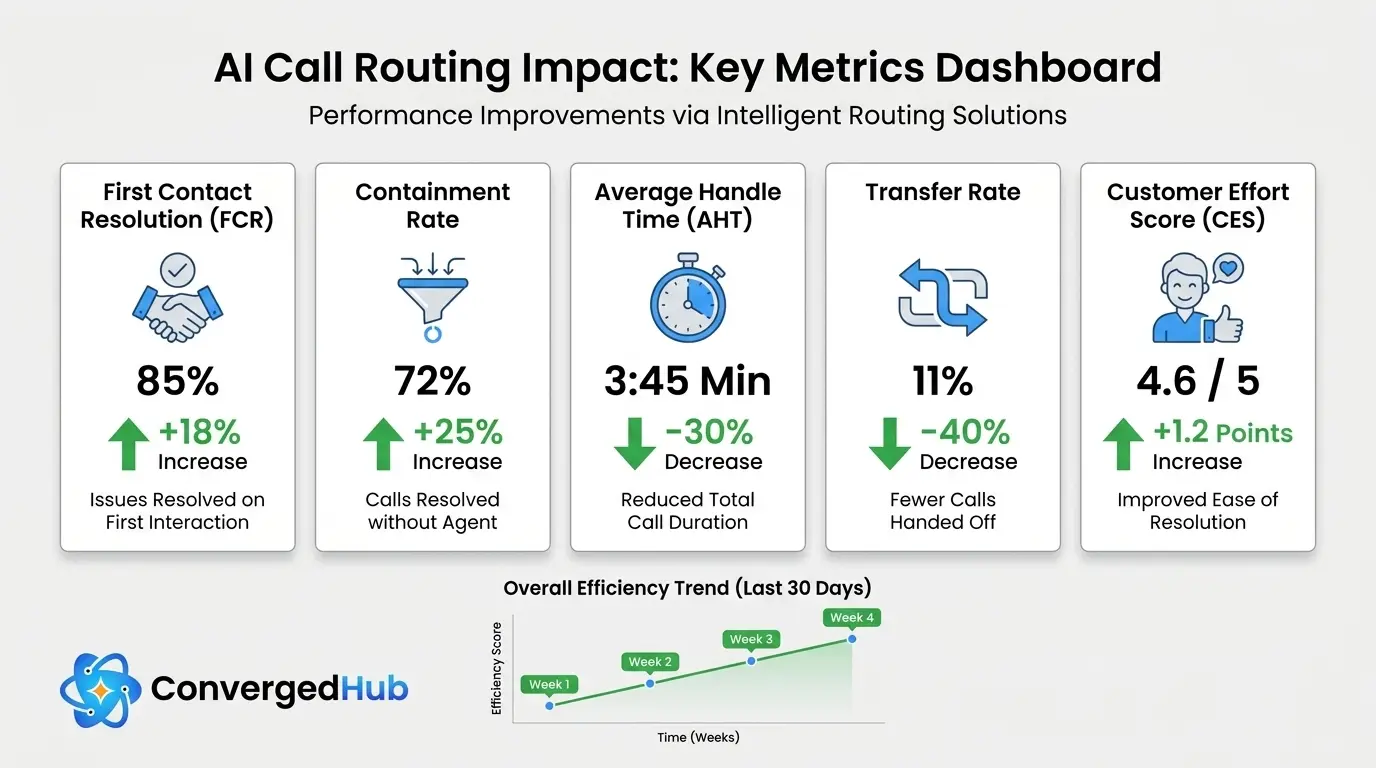
Benefits and metrics that matter
For CX and transformation leaders, AI call routing is compelling because it moves multiple needles at once. When implemented well, it delivers improvements in speed, experience, and efficiency.
- Faster time to answer and resolve: By matching each interaction to the right resource on the first try, AI reduces hold times, transfers, and dead ends. This directly impacts service level adherence and customer effort.
- Higher self service containment: Well defined intents are resolved end to end through automation, while complex or emotionally charged issues reach humans with full context. That balance lowers cost to serve without creating digital dead ends.
- Better agent productivity and satisfaction: Agents receive cases that fit their skills and authority, along with previews of intent, sentiment, and history. Agent assist tools further cut handle time and after call work, which can reduce burnout.
- Improved fairness and compliance: Policy driven routing enforces entitlements, fraud checks, and regional rules in a consistent way. You can encode compliance requirements into the routing fabric rather than relying on manual judgment alone.
- Increased loyalty and revenue: Right first time routing reduces frustration and makes it easier for customers to stay and buy more. Research on customer effort and loyalty from firms such as Google Cloud Contact Center AI highlights how small reductions in effort can have outsized impacts on retention.
- Continuous optimization: Because everything is instrumented, routing becomes an ongoing optimization program. CX teams can monitor containment by intent, track transfer reasons, and identify where knowledge gaps or process issues are driving unnecessary contacts.
From a measurement standpoint, AI call routing should show up in your dashboards as improvements in first contact resolution, average handle time, service level adherence, customer effort score, and cost per contact. Successful programs make these metrics and their baselines explicit before rollout.
Designing, selecting, and scaling
Moving from legacy routing to AI call routing is as much a design and change initiative as it is a technology project. The right approach and platform choices can make the difference between incremental improvement and a step change in experience.
Design journeys, not menus
Begin with a small number of high volume, high value intents, such as outage triage, billing and payments, or common account changes. Map the end to end journey for each, including emotional peaks, and identify where automation adds value and where humans are essential. Resources from experts like Nielsen Norman Group on journey mapping can help structure this work.
Use that understanding to design conversational entry points that feel natural. AI call routing works best when customers can speak or type in their own words instead of guessing which menu option is closest.
What to look for in a platform
When evaluating vendors, look for capabilities such as:
- Robust NLU and speech: High quality recognition across accents and domains, trained and tunable using your own transcripts and outcomes.
- Transparent policy engine: A clear, auditable way to combine machine learning with business rules so that routing decisions can be explained and adjusted by CX leaders.
- Integrated context: Native connectors to CRM, ticketing, knowledge bases, and workforce management so routing decisions see the full customer and agent picture.
- Omnichannel and converged experiences: Consistent routing across voice, chat, messaging, and email, plus the ability to blend voice with visual steps like forms, uploads, and carts in a single flow.
- Agent assist and copilot tools: Real time suggestions, summaries, and compliance prompts embedded directly in the agent desktop.
- Measurement and experimentation: Built in deflection analysis, containment tracking, and A B testing of prompts and flows.
- Security, privacy, and governance: Support for frameworks such as the NIST Privacy Framework and standards like ISO 27001, along with role based access, data minimization, and human override paths.
- Reliability at scale: Proven concurrency limits, redundancy, and graceful fallbacks so customers are never stranded if an AI component is unavailable.
Common pitfalls to avoid
- Over automation without guardrails: Forcing customers to stay in automation when intent confidence is low or sentiment is negative is a fast path to churn.
- Black box decisioning: If teams cannot see why calls were routed a certain way, they cannot debug or satisfy audit requirements.
- Ignoring data quality: Poor transcripts, outdated CRM records, or thin knowledge bases will degrade routing accuracy.
- Static flows that never learn: Treating AI call routing as a one time deployment rather than an optimization program undermines its value.
- Skipping agent readiness: Agents need training on new call mixes, as well as tools and authority to handle more complex work.
Practical rollout blueprint
A pragmatic path looks like this:
- Define success metrics for a small set of intents, such as containment rate and transfer reduction.
- Integrate AI call routing with your telephony, CRM, and knowledge systems.
- Launch a limited pilot, monitor voice of customer and agent feedback, and adjust thresholds for when to escalate.
- Expand to additional intents and channels, introduce converged voice plus visual experiences, and tune policies for segments and tiers.
- Institutionalize an ongoing review of routing performance as part of CX governance.
When treated as a continuous program rather than a one time project, AI call routing becomes a strategic lever for both cost optimization and differentiated experience.
AI call routing replaces guesswork and menu mazes with an intelligent decisioning layer that understands why customers are reaching out and what your business can do for them in that moment. For CX leaders and digital transformation teams, it is a practical way to blend automation, human expertise, and converged experiences into a single, adaptive system.
Start small, measure ruthlessly, and give agents the tools they need to thrive in this new model. With the right platform and governance, AI call routing can deliver faster answers, calmer agents, and customers who feel understood every time they get in touch.