Your best AI experience can turn into your worst privacy incident in a single sentence. The same system that remembers a customers history and resolves issues in seconds can also surface a detail that feels intrusive, raising questions about how much you really know and what you are doing with it.
For CX leaders and digital transformation owners, this is the new competitive frontier. Customers expect brands to join up data across channels, anticipate intent, and keep them out of queues. At the same time, they expect firm protection, clear purpose limits, and genuine control over how their information feeds AI.
This article explores how to balance personalization privacy AI in conversational experiences across voice, chat, and converged journeys. You will get practical design patterns, measurement ideas, and vendor criteria that help you deliver tailored CX without crossing the line that breaks trust.

Conversational Voice AI – Value Estimator
Quantify the business impact of Conversational Voice AI in minutes.
Use this estimator to:
- Build a data-backed ROI narrative to support executive and board-level decision-making
- Model potential cost savings driven by Voice AI–led call automation and containment
- Quantify productivity gains from reduced agent workload and lower average handle time
- Assess operational efficiency improvements across high-volume voice interactions
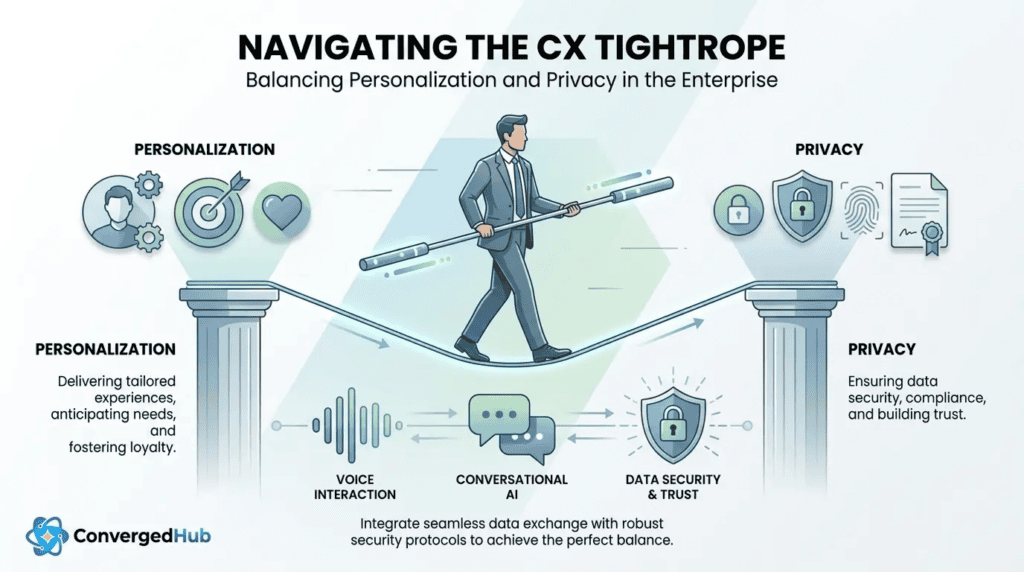
The CX Personalization Tightrope
Consider a telecom contact center where an AI assistant recognizes a returning caller, confirms identity with minimal friction, and pulls up the exact plan details an agent needs. The experience feels effortless and human, even if no human is yet involved.
Now shift to a similar call where the AI references a past location-based interaction the customer does not remember opting into. The data use might be technically legal, yet it feels like surveillance. The emotional response flips from appreciation to concern, and the brand has just created a risk that may end up in social feeds or regulator inboxes.
A retail bank that deploys an AI recommendation engine to reduce churn faces the same issue. Training on transaction histories, the model successfully flags likely interest in new credit products. Conversions rise, but a vocal minority starts asking why the bank knows so much and how that insight will be used next. Short term uplift, long term distrust.
The lesson for CX and digital leaders is clear: personalization is judged not only by outcomes, but by expectedness. Customers routinely share data in apps, IVR flows, and chats, yet they carry mental boundaries about what is acceptable in each channel. Conversational AI and converged experiences, such as voice assistants handing off to visual flows, must respect those boundaries by design.
Why Personalization Still Wins
Despite these risks, personalization is still one of the highest return levers in modern CX. Research from McKinsey shows that companies that excel at personalization generate significantly more revenue and customer loyalty than peers that treat every interaction as generic.
For conversational and contact center leaders, effective personalization translates into:
- Faster resolution: AI can prefill context, verify identity with fewer steps, and route to the right agent or bot skill the first time.
- Reduced effort: Next best action and agent assist features prevent repetitive questions and allow agents to focus on what humans do best, such as empathy and complex judgment.
- Higher satisfaction and loyalty: When the system remembers channel preferences, previous issues, and safe routine actions, the experience feels respectful and competent rather than scripted.
- Efficiency at scale: Automation of common intents, contact center copilots, and deflection analysis shrink queues without sacrificing quality.
The leaders in personalization privacy AI understand that the value is created when personalization is anchored to an explicit customer need: fix my problem, save me time, or protect me from risk. The goal is not to show how much data you hold, but to show how well you can use minimal data to deliver a better outcome.
Privacy, Law, and Perception
Privacy is no longer an internal compliance exercise. It is a live element of the customer experience that shapes trust, loyalty, and brand sentiment. Global frameworks such as GDPR and state laws such as CCPA make this explicit through principles like data minimization, purpose limitation, and user rights to access, correction, and deletion.
Sector specific rules, such as HIPAA in healthcare and the Gramm Leach Bliley Act in financial services, add further constraints on how conversational data can be used, stored, and shared. Emerging guidance such as the NIST AI Risk Management Framework stresses the need for transparency, explainability, and continuous monitoring of AI systems.
Yet even full legal compliance does not guarantee customer comfort. Perception often hinges on four simple questions:
- Why did you collect this data in the first place
- How long will you keep it and where
- Can I see, change, or delete it
- What happens if something goes wrong
When CX teams ignore these concerns, AI that could delight ends up driving complaints, escalations, and opt out. The opportunity is to design conversational journeys where privacy is visible, not hidden in policy links, and where personalization privacy AI choices are communicated at the exact moment they matter.
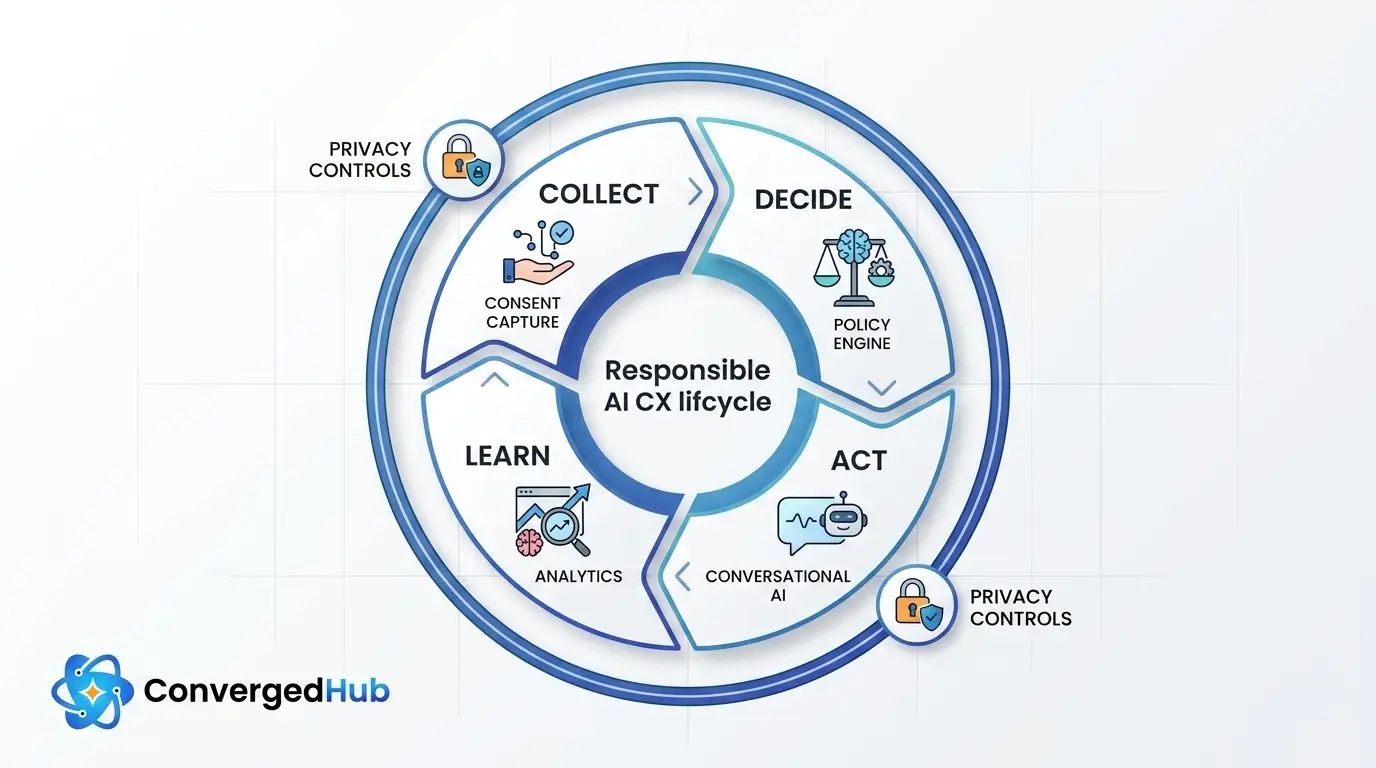
Blueprint for Responsible AI CX
Balancing value and risk in AI driven CX requires a blueprint that links data decisions to experience design. The following practices are most effective when they are implemented consistently across IVR, chatbots, live agents, and converged voice plus visual experiences.
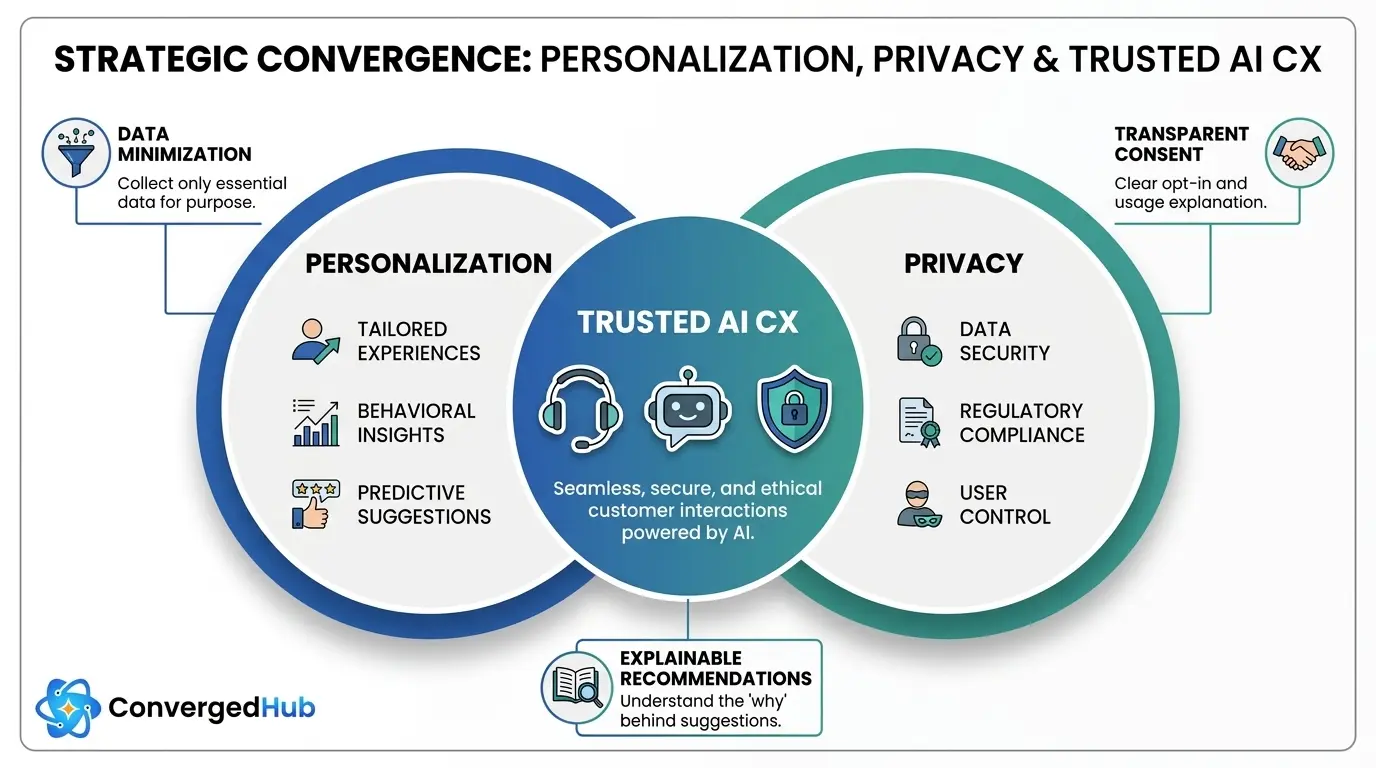
1. Practice strict data minimization
Start with the smallest set of data needed to achieve a specific outcome. Favor first party and zero party data that customers knowingly provide. Avoid pulling in sensitive attributes such as health, precise location, or financial stress signals unless there is a clear, documented, and communicated need.
2. Build real consent and preference management
Replace vague banners with plain language that explains what you collect, why, and for how long. Offer granular toggles, such as recommendations on or off and channel specific personalization. Ensure a customers decision follows them across web, mobile app, chat, and voice, rather than resetting per channel.
3. Be transparent in the moment
Surface micro disclosures inside the experience, not just in policy pages. For example, a bot could say, We are suggesting this based on your last order. You can manage this in your preferences. This reduces surprise and lowers the volume of privacy related contacts.
4. Anonymize and pseudonymize by default
Use aggregation, tokenization, and pseudonymization for analytics and model training wherever possible. Keep identifiable data out of test environments. Separate keys from datasets and enforce role based access so that sensitive information is only visible when operationally required.
5. Engineer secure data handling
Protect conversational streams in transit and at rest, apply least privilege access, and enable continuous monitoring. Log model inputs and outputs for audit, but avoid retaining raw identifiers longer than needed. Tie retention policies directly to clearly defined business purposes.
6. Give customers meaningful control
Provide a unified preference center that spans your digital estate, including IVR and chat. Make it easy for people to view, download, correct, or delete their data, and to switch specific personalizations off without losing access to service. In a converged platform, this control layer should be part of the core design, not a bolt on module.
From Metrics to Real Use Cases
Trust feels intangible, but it can be measured and managed like any other CX outcome. When you treat trust as a KPI, you can make better product choices and defend investments in responsible AI.
Useful indicators include:
- Consent patterns: Trends in opt in and opt out by channel and segment after you change journeys or messaging.
- Trust related complaints: Volume and severity of contacts that mention data use, creepy experiences, or surprise at what the brand knows.
- Privacy ticket handling: Time to resolve access, deletion, or consent related tickets, and the number of handoffs required.
- Preference adherence: Errors where systems or agents ignore a stated preference, as detected by quality monitoring or conversational analytics.
Once you can see these metrics in a converged dashboard, you can confidently deploy high value use cases such as:
- Guided self service: Use recent order or claim data to pre populate returns or status checks, but ask permission before loading historical addresses or payment details.
- Agent assist with guardrails: Show agents relevant tickets, products owned, and steps already attempted, while masking sensitive fields until there is a verified need to view them.
- Proactive outreach with consent: Send outage alerts, appointment reminders, or fraud warnings based on explicit opt ins and preferred channels, not inferred interests.
- Service first next best action: Offer troubleshooting and education before cross sell offers. In contact center copilots, bias ranking toward resolving the current issue, then suggest value adds only when appropriate.
- Churn saves without overreach: Trigger save offers from behavioural signals such as repeat failures, long handle times, or silent dissatisfaction rather than inferring sensitive traits.
Each of these patterns shows customers that the brand is using data to help them, not to surprise or pressure them, reinforcing the positive side of personalization privacy ai.
Guardrails, Vendors, and Pitfalls
Delivering safe, effective AI CX at scale is rarely a solo effort. Most enterprises work with platforms and partners, so it is vital to know what to look for when you evaluate conversational AI and contact center solutions.
Key capabilities that signal privacy by design include:
- Clear data maps and purpose limits: Documentation that shows which data flows where, for what reason, and with what retention schedule.
- Flexible deployment options: Support for on premises, virtual private cloud, or regional hosting to meet localization and residency needs.
- Runtime guardrails: Policy engines, PII detection, and output filters that can redact sensitive data, block unsafe prompts, and enforce consent rules in real time.
- Explainable recommendations: Ability to show which signals informed a suggestion, phrased in language that agents and customers can understand.
- Data minimization tooling: Field level controls, short lived tokens, and automatic retention and deletion policies.
- Anonymization support: Pseudonymization and aggregation for analytics and training workloads.
- Human in the loop controls: Review workflows for sensitive automations, such as major credit decisions or high risk medical guidance.
- Auditability and reporting: Immutable logs for consent, access, and model decisions that support both internal risk teams and regulators.
- Preference center integration: Respect for do not track and do not sell or share flags across channels, including voice transcripts and chat logs.
- Strong vendor posture: Independent security assessments, clear incident response playbooks, and transparent subprocessor lists.
At the same time, avoid common pitfalls that repeatedly derail AI CX programs:
- Collecting data just in case rather than for defined purposes.
- Hiding consent in dense legal text or bundling it with unrelated terms.
- Using inferred sensitive traits such as health or income in scripts.
- Repurposing service data for marketing without explicit permission.
- Making opt out journeys harder than opt in flows.
- Keeping data indefinitely or lacking documented deletion processes.
- Allowing unvetted integrations that can exfiltrate prompts or transcripts.
Three questions come up often from CX leaders:
Do you need explicit consent for every personalized interaction
Not always. For service personalization, a legitimate interest basis may apply, especially when it reduces friction for the customer. For marketing personalization, explicit opt in is usually safer and sometimes required. In both cases, be transparent, avoid sensitive attributes unless consented, and provide easy ways to change preferences.
Can you personalize effectively with less data
Yes. Many of the biggest wins come from high signal, low risk data such as recent interactions, session context, and stated preferences. Short lived context windows and anonymized aggregates for model tuning can deliver strong performance without amassing large stores of personal data.
How do you prevent creepy moments in voice or chat
Adopt a relevance first rule: only reference data that a reasonable customer expects you to have in that channel. Use policy checks to block sensitive attributes from being surfaced in prompts or responses. Test scripts with real customers, analyse conversational insights, and regularly adjust tone and content based on feedback.
Customers reward brands that respect boundaries as much as they reward speed and convenience. The most successful CX and digital leaders do not treat privacy as a brake on innovation; they treat it as the design constraint that makes their AI truly competitive.
By integrating personalization privacy AI into your operating model, you can collect less, explain more, secure by default, and put control where it belongs, in the customers hands. With the right guardrails, consent patterns, and trust metrics in place, conversational platforms can deliver tailored voice and chat experiences that feel helpful, not invasive, turning trust into a durable advantage.