
The first time the board asks how much value generative AI will unlock in customer experience, most Digital Transformation leaders reach for two things: a few pilot success stories and a hopeful spreadsheet. Within minutes, the CFO starts drilling into channel mix, seasonality, and risk. The optimistic spreadsheet starts to look fragile.
Forecasting AI ROI in customer experience is no longer optional. CX automation is moving from experiments in a single chat channel to enterprise scale across voice, messaging, and digital journeys. Without a disciplined way to project value, investments stall, or worse, succeed on adoption but fail on economics.
This guide is built for CX, Digital Transformation, and Innovation leaders who need a pragmatic forecasting model from pilot to scale. We will break down total cost of ownership, demand and capacity planning, scenario analysis, and governance, all through the lens of converged voice and chat experiences.
Use it as a working blueprint: plug in your own volumes, unit costs, and expected improvements. By the end, you will have a clear way to quantify AI ROI in customer experience, de risk your roadmap, and have a more confident story when the board asks what you will deliver next year and beyond.
Why CX AI ROI Is Hard To Predict
Customer experience has always been multidimensional. It spans emotional perception, operational efficiency, and long term loyalty. Generative AI magnifies that complexity because it does not just automate single tasks; it changes how customers and agents collaborate across every channel.
Analysts such as Gartner frame customer experience as the sum of all interactions and perceptions a customer has with a brand. When you introduce large language models into that system, you affect contact center costs, digital containment, agent performance, and even product discovery. That makes AI ROI in customer experience powerful, but also harder to forecast.
Common reasons forecasts fall apart include:
- Copying chatbot business cases from the past decade. Traditional FAQ bots aimed only at deflection. Modern conversational AI and agent assist can also lift revenue, reduce churn, and improve compliance. Old models miss these dimensions.
- Ignoring channel convergence. Voice, chat, and messaging are usually modeled in separate silos. In reality, a customer may start in self service chat, escalate to voice, and later receive a proactive message. AI influences the full journey.
- Treating cloud and LLM usage as fixed costs. In practice, usage based pricing, model choice, and orchestration patterns cause unit costs to change as you scale.
- Underestimating human in the loop. Supervisors, conversation designers, and quality analysts are crucial for safety and continuous improvement. Their time is a material line in total cost of ownership.
- No explicit risk view. Many pilots are approved on soft benefits and innovation value. At scale, risk and compliance leaders will ask how you price downside scenarios such as wrong answers, bias, or brand damage.
These pitfalls do not mean you cannot forecast. They mean you need a more structured model that connects CX outcomes to technical design and operating realities. That model starts with a clear definition of value.
Clarify Outcomes Before You Model
Before you run numbers, define the business outcomes your conversational AI portfolio will serve. Every board conversation eventually collapses into three categories: cost, revenue, and risk. AI ROI in customer experience is simply the net effect across those three buckets over time.
A practical way to design this is to build a simple value tree.
Step 1: Choose anchor CX metrics
Pick 4 to 6 metrics that matter most to your organisation and investors. For a CX and Digital Transformation leader, these usually include:
- Cost per contact in the contact center
- Average handle time and first contact resolution
- Self service containment rate and channel shift
- Customer satisfaction or Net Promoter Score
- Churn rate and customer lifetime value
- Compliance incidents or complaints per 10 000 interactions
These metrics are directly linked to enterprise value. For instance, Harvard Business Review research has shown that customers with the best past experiences tend to spend more and remain longer, boosting both revenue and profitability.
Step 2: Map AI use cases to those metrics
List your planned AI use cases across voice and digital. Examples:
- Natural language self service for order status, billing, and simple troubleshooting
- Voice authentication to reduce manual verification time
- Agent assist to summarise calls, suggest responses, or surface knowledge
- Next best action recommendations during retention or sales conversations
- Proactive messaging for renewals, outages, or follow up after high effort interactions
For each use case, specify which anchor metrics it will influence and how. For example, voice authentication reduces handle time, which reduces cost per contact and may also improve customer satisfaction by shortening frustrating security questions.
Step 3: Define baselines and realistic ranges
Forecasts are only as good as their baseline. For each metric, document:
- Current level, for example average handle time of 8 minutes or cost per assisted contact of 6 units
- Historical trends over the past 12 to 24 months
- Expected change range with AI, for example 5 to 15 percent faster handle time or 10 to 25 percent more digital containment
Use ranges, not single point estimates, to reflect uncertainty. You will then create conservative, base, and aggressive scenarios from these ranges later in the guide.
With this value tree in place, you can have a focused conversation about which levers matter, instead of abstract debates about artificial intelligence in general. Now you are ready to quantify the cost side through a robust TCO model.

Build A Full Conversational AI TCO
Total cost of ownership for CX AI is more than model usage. To forecast AI ROI in customer experience accurately, you need to capture both technology and operating costs, and to recognise how a converged platform can amortise those costs across channels and journeys.
A useful structure is to group TCO into six categories:
1. Platform and infrastructure
These are the foundational costs to run conversational workloads at scale:
- Cloud infrastructure or platform subscription for your conversational AI stack
- Telephony and contact center as a service integration for voice channels
- Speech to text and text to speech services for voice interactions
- Data storage for transcripts, embeddings, and logs
Cloud providers such as Microsoft Azure outline best practices for modelling infrastructure TCO, including rightsizing, autoscaling, and reservation strategies.
2. LLM and NLU usage
Usage based costs include:
- Large language model calls, usually priced by tokens or requests
- Retrieval augmented generation calls to your vector store or knowledge index
- Specialised NLU components such as intent classification or entity extraction
These costs scale with interaction volume, average turns per conversation, and the specific models you choose. One advantage of a converged setup, such as the ConvergedHub AI approach, is that you can share a single orchestration layer and knowledge backbone across channels, which improves utilisation and control of model usage.
3. Integration and data engineering
To deliver meaningful journeys, your assistant must read and write from systems of record:
- CRM and case management platforms
- Order and billing systems
- Identity and access management
- Analytics and data warehouse platforms
Integration work includes initial development and ongoing maintenance as upstream systems evolve. This is often a significant line item in the first year and then a smaller but steady run rate cost.
4. Monitoring, analytics, and tooling
High stakes CX automation requires robust monitoring:
- Real time dashboards for containment, transfer, handle time, and sentiment
- Conversation quality review tools and annotation interfaces
- Model performance monitoring, including hallucination or drift detection
Cloud architecture guides such as the Google Cloud cost optimisation framework emphasise that observability is not an optional extra. It is central to controlling spend and improving performance over time.
5. Human in the loop and operations
People remain in the loop at every stage:
- Conversation designers and product owners who shape flows, tones, and prompts
- Supervisors who review difficult conversations, annotate data, and refine policies
- Operational run teams who manage configuration, releases, and incident response
In many mature programmes, these human costs are 25 to 40 percent of total annual spend. Underestimating them leads to overly optimistic ROI.
6. Change management and training
Finally, budget for change:
- Agent training on new workflows and agent assist tools
- Playbooks and guardrails for supervisors
- Internal communication so staff understand how AI augments rather than replaces them
In a converged experience strategy, multiple channels and business units share this foundation. That means each new use case or channel adds marginal cost instead of starting a new stack. Your forecast should therefore model TCO over a 3 to 5 year horizon, showing how platform investment in year one supports a growing portfolio of voice and chat automations in later years.
A simple table for your financial partners can summarise this:
| Category | Year 1 | Year 2 | Year 3 |
|---|---|---|---|
| Platform and infra | High setup | Medium | Medium |
| LLM and NLU usage | Medium | High | High |
| Integration and data | High setup | Low | Low |
| Monitoring and tools | Medium | Medium | Medium |
| Human in the loop | Medium | Medium | Medium |
| Change and training | Medium | Low | Low |
You can then overlay this cost view with demand forecasts, which we will explore next.
Forecast Volume, Mix, And Seasonality
Demand forecasting is where finance, operations, and AI architecture meet. To project AI ROI in customer experience, you must estimate how many interactions your assistants will handle, in which channels, with what level of automation, and how that changes over time.
Step 1: Start from historical interaction data
Aggregate at least 12 months of contact volumes across:
- Voice calls into your contact center
- Live chat and messaging sessions
- Key self service journeys such as web or app flows
Segment by intent category where possible: billing, orders, technical support, password reset, new sales, retention, and so on. This gives you a grounded view of how customers actually use your channels today.
Step 2: Identify automatable segments
Classify each segment by complexity and sensitivity:
- Tier 1 simple, well structured tasks such as order status, FAQs, password reset
- Tier 2 moderately complex tasks with branching logic or multiple systems, such as billing disputes or simple troubleshooting
- Tier 3 complex or emotionally sensitive interactions such as complaints, retention saves, or high value sales
Most programmes start by automating a high share of Tier 1, a smaller share of Tier 2, and keeping Tier 3 largely assisted, augmented by AI for agents.
Step 3: Model adoption and containment curves
For each tier and channel, define quarterly assumptions for:
- AI adoption share of total volume that enters an AI mediated flow, for example a virtual agent or agent assist
- Containment share of interactions fully resolved without human intervention
- Average conversation length in turns or minutes
In early quarters, adoption may be limited by routing rules and change management. As your team gains trust and proven value, more intents and segments shift into AI flows.
Step 4: Convert to capacity and cost drivers
Translate demand into the units that drive TCO:
- Voice minutes handled by AI versus humans
- Chat messages and average concurrent sessions
- Estimated LLM tokens per interaction
- Peak concurrent sessions during busy hours or seasonal peaks
For example, suppose you handle 10 million contacts per year, 60 percent voice and 40 percent chat. If in year two your plan is for 40 percent of Tier 1 and 20 percent of Tier 2 interactions to be fully automated, you can calculate how many of those 10 million contacts will be handled by AI and how many will still need an agent.
This in turn informs your contact center resourcing, infrastructure sizing, and model usage forecasts. It also supports better planning for seasonal peaks such as holidays or regulatory deadlines, where you may want to increase AI coverage temporarily to avoid long waits for customers.
Step 5: Plan for behaviour change
One subtle effect of high quality CX automation is that you may unlock new demand. When it becomes easier and faster to get help, some customers will use support or advisory services more often. Build sensitivity analysis into your models for this uplift effect, especially in high value journeys such as financial advice or premium support.
By combining a clear TCO structure with a demand forecast by channel and intent, you can now build integrated scenarios for cost, revenue, and risk.

Scenario Templates For CX AI ROI
With value drivers, TCO structure, and demand forecasts defined, you can now build scenarios that show how AI ROI in customer experience behaves under different assumptions. Use three standard templates as a starting point: cost, revenue, and risk.
Template 1: Cost and efficiency scenario
Objective: Show impact on operating cost and capacity.
Inputs:
- Annual contact volume by channel and intent
- Cost per assisted contact and cost per AI handled contact
- Planned adoption and containment rates over 12 to 36 months
- Total TCO from your cost model
Simple structure:
- Calculate baseline annual cost with no AI intervention
- Calculate projected annual cost with AI, including lower assisted volumes, AI operating costs, and TCO amortisation
- Net annual savings equal baseline minus projected cost
For example, if your baseline cost per assisted contact is 6 units and you automate 3 million of 10 million annual contacts at an AI unit cost of 1.5 units, you can quantify gross savings and compare them to platform and integration costs. This gives finance a clear view of payback period and breakeven month.
Template 2: Revenue and growth scenario
Objective: Show how better experiences and proactive engagement increase revenue and lifetime value.
Inputs:
- Volumes for sales, upsell, and retention journeys
- Baseline conversion rates and average order or contract value
- Expected uplift from AI, such as improved recommendations or higher completion rates
- Churn reduction estimates linked to improved service experiences
Simple structure:
- Model incremental revenue from higher conversion in assisted and automated journeys
- Model incremental revenue from lower churn over a typical customer lifetime
- Subtract AI costs related to these journeys to get net revenue impact
For instance, agent assist might surface more relevant cross sell offers during support calls, lifting conversion by a modest percentage. Even a small uplift at scale can more than cover the AI operating cost, especially in high margin products.
Template 3: Risk and compliance scenario
Objective: Quantify downside protection and risk adjusted value.
Inputs:
- Historical data on complaints, escalations, or regulatory incidents
- Average financial impact of a severe incident, including fines or legal costs
- Expected reduction in such incidents through consistent AI guided flows and monitoring
Simple structure:
- Estimate expected annual loss without AI as probability of incident multiplied by impact
- Estimate expected annual loss with AI using lower incident probabilities
- Risk reduction benefit equals the difference between those two values
Risk is inherently harder to quantify and should be presented as a range. However, boards increasingly expect a structured view rather than qualitative statements alone, especially in regulated industries.
Bringing the scenarios together
Combine your three templates into integrated conservative, base, and aggressive cases. Each case should clearly show:
- Total benefits from cost, revenue, and risk reduction
- Total TCO, split into one time and recurring components
- Key metrics: net present value, payback period, and ROI percentage
This scenario pack becomes the financial backbone of your roadmap, against which you can track actuals and refine assumptions over time.
Roadmap And Governance For Scale
Even the best forecast will erode if there is no plan for how to scale and govern AI in customer experience. To protect and grow AI ROI in customer experience, you need a phased roadmap and a clear operating model.
Phase 1: Quick wins with guardrails
Focus the first 6 to 12 months on use cases with high volume, low complexity, and clear outcomes:
- Virtual agents for status checks, simple updates, and FAQs
- Agent assist for summarisation and suggested responses
- Automated after call work and case notes
Limit the initial surface area to reduce risk and reward early adopters. Establish success metrics and a cadence for reviewing performance and feedback.
Phase 2: Orchestrated journeys across channels
Once you demonstrate value, expand into journeys that span channels and systems:
- Seamless handoff between chat, voice, and human agents with full context transfer
- Deeper integration with CRM and order systems to enable transactional self service
- Personalised experiences using customer history and preferences
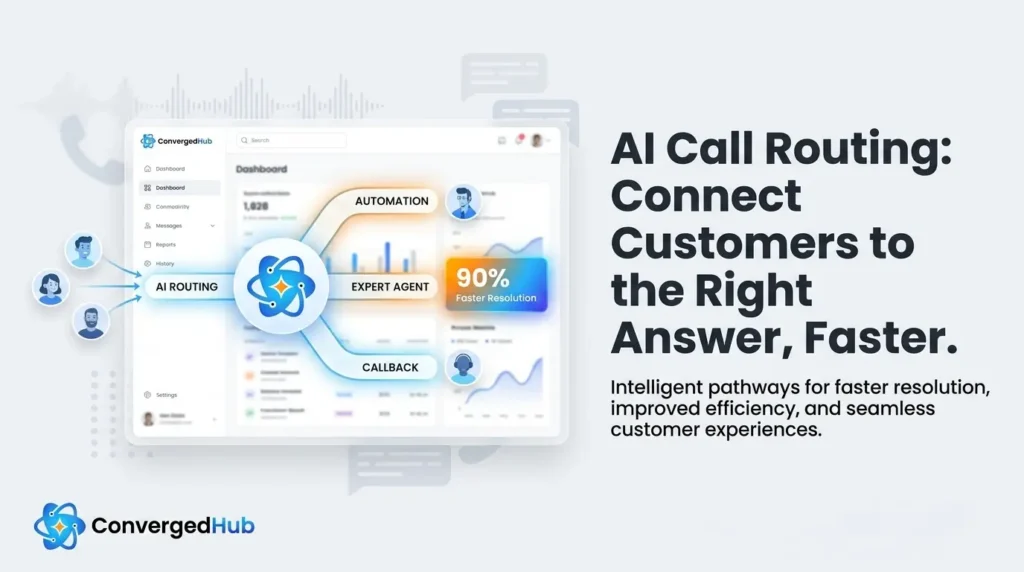
This is where a converged platform such as ConvergedHub AI shows its advantage. Instead of building separate bots, you orchestrate one conversational brain that manifests in voice, chat, and messaging but learns from every interaction.
Phase 3: Converged, proactive experiences
In the longer term, your roadmap can move beyond reactive support:
- Proactive outreach for renewals, servicing, or exception handling
- Embedded conversational experiences inside your products and apps
- Closed loop learning where model updates are driven by CX outcomes and human feedback
At this stage, AI is part of your core digital fabric, not an add on channel.
Governance checkpoints that protect ROI
Throughout all phases, governance keeps returns durable:
- Design and approval gates. Cross functional review of new use cases, including CX, legal, risk, and security.
- Responsible AI standards. Alignment with frameworks such as Google Cloud responsible AI principles, tailored to your context.
- Performance and drift monitoring. Regular review of containment, satisfaction, and error rates with clear triggers for retraining or rollback.
- ROI tracking. Quarterly reconciliation of forecast versus actual benefits and costs, with updates to your scenarios and roadmap.
A governance rhythm ensures that AI aligns with brand values, regulatory expectations, and economic targets. It also gives executives confidence to support bolder investments over time.
With this roadmap and governance model in place, you can treat your forecast as a living instrument, not a one time business case.
Forecasting AI ROI in customer experience is ultimately about owning the narrative of how technology and human expertise combine to serve customers better and grow the business. With a structured approach to value, cost, demand, and governance, you can move from speculative hype to repeatable, provable outcomes.
Use this guide as a starting point for your own models and conversations. Bring CX, finance, risk, and engineering together around a shared set of assumptions and scenarios. As you learn from real world data, refine the numbers and update the roadmap.
In doing so, you will not only answer the next board question with confidence. You will build a sustainable, converged AI capability that delivers measurable value at every stage of the customer journey.