
Most enterprise AI efforts do not fail because of models or infrastructure. They stall because culture, incentives, and ways of working were designed for a world of queues and tickets, not real time, AI infused conversations across voice and chat.
For CX and digital transformation leaders, the strategic question is no longer whether to deploy AI. It is how to design a CX culture that keeps humans at the center while AI scales empathy, insight, and speed across every touchpoint.
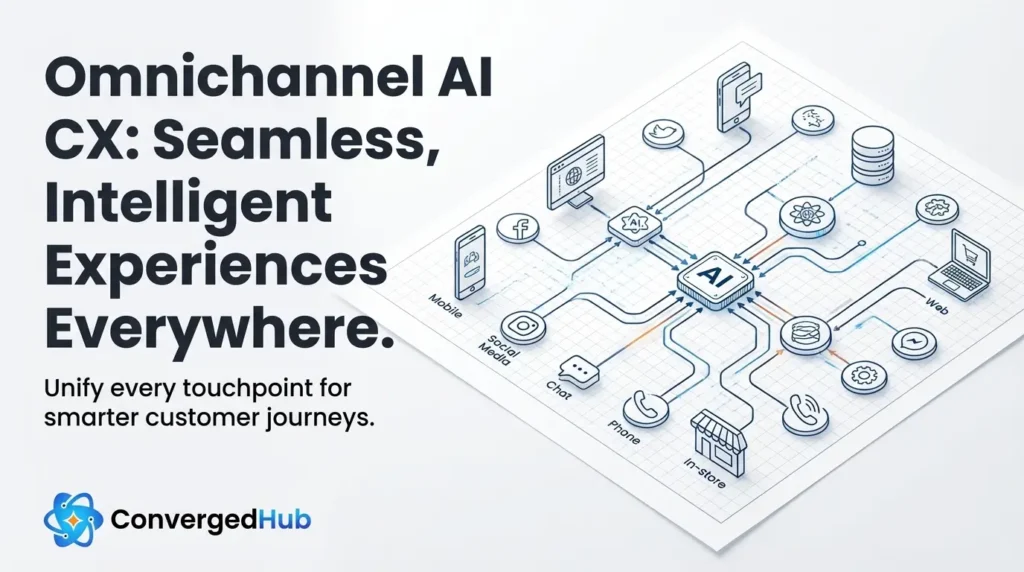
This playbook explores CX Culture AI as a system of mindsets, workflows, and incentives that turns conversational AI and automation into a durable enterprise capability. It is written for leaders who want to move beyond pilots and proof of concepts to a converged experience where customers move fluidly between channels, and AI quietly orchestrates what happens behind the scenes.

The CX Leader’s AI Implementation Playbook
The CX Leader’s AI Implementation Playbook is your step-by-step guide to navigating the AI revolution in customer experience. With practical frameworks, industry spotlights, and proven strategies, it gives you the roadmap to build the business case, design credible pilots, scale responsibly, and deliver measurable ROI in the next 100 days and beyond.
Defining CX Culture in the AI Era
Many organizations treat CX Culture AI as a technology decision: buy a platform, build a few bots, and wait for the metrics to improve. In reality, it is a cultural and operating model shift that defines how your enterprise thinks, decides, and collaborates around customer interactions.
At its core, CX Culture AI is:
- Customer obsessed: Every AI use case starts from specific pain points in the journey, not from available tools or models.
- Human centered: AI augments employees and customers, but does not replace human judgment, accountability, or empathy.
- Conversation led: Voice and chat data are treated as strategic assets that reveal intent, emotion, and friction in real time.
- Systemic, not siloed: CX, IT, data, and operations co design AI powered experiences rather than pushing work across functional boundaries.
Harvard Business Review has shown that organizations that integrate AI into management systems and culture outperform those that treat it as a side project. The same principle applies to customer experience. Without cultural alignment, the best conversational AI platform will deliver only local improvements, not enterprise transformation.
Defining CX Culture AI clearly and explicitly is the first step. It creates a shared language across business and technology leaders and sets expectations that AI will change how people work, not simply add more tools to an already crowded stack.
Foundations of Human Centered AI
Human centered AI in CX is not a vague aspiration. It rests on four cultural foundations that shape day to day decisions across contact centers, digital channels, and operations.
1. Customer centricity with real listening
AI makes it possible to listen at scale through speech analytics, chat transcripts, and behavioral signals. A human centered culture turns these signals into shared insight, not surveillance or scorekeeping. Customer stories and call snippets are played in leadership meetings. Journey maps are updated based on real conversations, not assumptions.
2. Data driven decisioning
AI thrives on high quality, accessible data. Yet many enterprises still make key CX choices based on anecdote. A strong CX Culture AI treats data as a product: curated, cataloged, and governed so that teams can safely experiment with use cases. Resources like McKinsey insights on analytics driven organizations highlight how this discipline accelerates value.
3. Experimentation as a habit
Instead of long, waterfall projects, teams run controlled experiments: new bot flows in one region, new routing logic for a subset of calls, or different proactive outreach messages. Learnings are shared in open forums, and failures are treated as tuition, not blame.
4. Collaboration over handoffs
Customer conversations do not respect org charts. Human centered CX Culture AI builds cross functional squads that own end to end journeys. CX designers, contact center leaders, data scientists, and engineers sit together to refine intents, tune models, and redesign upstream policies that create contact volume in the first place.

Redesigning Frontline Roles
AI does not simply automate frontline tasks. It changes what frontlines are for. In an effective CX Culture AI, agents evolve from case handlers to orchestrators of complex, high value moments, supported by AI copilots.
From script followers to problem solvers: Routine inquiries are increasingly handled by virtual agents across voice and chat. Human agents focus on nuanced cases: emotionally charged situations, multi step resolutions, or high value customers. Their performance is measured less on handle time and more on quality outcomes, supported by AI generated summaries and recommendations.
AI as a real time coach: Modern conversational AI can surface next best actions, knowledge snippets, and compliance prompts in real time. A human centered culture presents these as suggestions, not mandates, and invites agents to give feedback when AI guidance is unhelpful. That feedback loop becomes training data to improve the system.
New roles around the conversation
- Conversation designers craft flows, tones, and escalation paths that feel natural across channels.
- Bot trainers and data annotators tune intents, entities, and guardrails based on real interactions.
- AI experience owners manage performance across bot and human touchpoints, not just within one channel.
Research from MIT Sloan Management Review has emphasized that AI delivers the most value when it augments human capabilities rather than seeking full automation. Designing frontline roles around augmentation sends a powerful cultural message: people remain central to customer trust.
Aligning CX, IT, Data, and Operations
Even the most advanced conversational AI stack will underperform if CX, IT, data, and operations are pulling in different directions. CX Culture AI requires an operating model that aligns these groups around shared outcomes.
Shared ownership of journeys
Instead of CX owning satisfaction, IT owning platforms, and operations owning efficiency, cross functional teams jointly own specific journeys, such as onboarding, claims, or subscription changes. Budgets and backlogs are tied to journey outcomes, not departmental projects.
One AI CX roadmap
Many enterprises have overlapping pilots in chatbots, IVR modernization, and analytics. A single AI CX roadmap, reviewed quarterly, clarifies which journeys, languages, and regions come next and how assets such as intent libraries, knowledge bases, and models will be reused.
Clear decision rights
Ambiguity over who decides what slows down scaling. A simple RACI model defines who owns experience design, who owns data, who approves risk, and who runs day to day operations. This allows teams to move quickly within clear guardrails.
Technical and process interoperability
Converged experiences depend on a common knowledge layer and shared understanding of customer identity across channels. IT and data teams establish standards for APIs, event streams, and data models so that voice bots, chatbots, and human desktops work from the same truth. Resources such as IBM guidance on AI and integration offer useful patterns for making this sustainable.

KPIs, Incentives, and Responsible AI
Culture follows measurement. If leaders celebrate only cost reduction and speed, AI will be deployed in ways that quietly erode trust. CX Culture AI requires KPIs and incentives that balance efficiency with experience, and automation with responsibility.
Redesigning success metrics
- From handle time to outcome quality: Track first contact resolution, issue recurrence, and customer effort scores alongside productivity metrics.
- From containment only to satisfaction plus containment: Measure bot containment together with post interaction CSAT, so that automation that frustrates customers is not rewarded.
- From channel metrics to journey metrics: Evaluate how well the combination of self service, human support, and proactive outreach resolves the customer intent.
Aligning incentives with adoption
Leaders at every level need visible reasons to invest time in AI transformation. This might include recognition for teams that contribute training data, nominate high value use cases, or improve AI driven processes even when it shifts work away from their own function.
Embedding responsible AI governance
Customers will not embrace AI driven experiences if they feel opaque or unfair. Frameworks such as the OECD AI principles offer guidance on transparency, accountability, and human oversight. Practical steps include:
- Reason codes or explanations for critical decisions.
- Escalation paths to humans when customers are confused or dissatisfied.
- Periodic reviews of training data and model outputs for bias.
- Ethics checkpoints in the AI CX roadmap before rollout.
Responsible AI is not a compliance add on. It is a cultural stance that signals to employees and customers that trust is a non negotiable part of innovation.
Scaling from Pilots to Enterprise
Almost every large organization now has AI pilots somewhere in CX. The real challenge is scaling from isolated experiments to enterprise wide, converged experiences across voice, chat, and digital channels. CX Culture AI provides the playbook for that leap.
Move from project to platform thinking
Instead of building a new stack for each use case, teams invest in shared components: an intent and entity library, a unified customer profile, reusable conversation templates, and centralized quality monitoring. New journeys plug into this platform rather than starting from zero.
Institutionalize learning loops
AI generates a constant stream of signals: misclassified intents, drop off points, unexpected escalation types. High performing organizations turn this into a continuous improvement engine:
- Weekly or biweekly review of conversation analytics by a cross functional squad.
- Rapid updates to bot flows, routing logic, and knowledge articles based on findings.
- Feedback channels for agents and supervisors to flag gaps in AI support.
Address resistance and skill gaps head on
Frontline teams may fear job loss; business leaders may worry about loss of control. Transparent communication about how roles will evolve, coupled with targeted upskilling in areas like conversation design, journey analytics, and AI literacy, turns resistance into engagement. Partnerships with learning platforms or universities, as well as guidance from organizations such as the World Economic Forum on future skills, can accelerate capability building.
Adopt a crawl, walk, run pattern
Successful CX Culture AI transformations rarely happen through one big bang launch. They follow a sequence of tightly scoped, measurable steps: start with one or two high volume intents, prove value, codify the playbook, and expand. Over time, the culture shifts from asking whether AI will work to asking where it should be applied next.
AI is rapidly reshaping what customers expect from every interaction: instant answers, seamless channel transitions, and personalized support at scale. Yet the differentiator for enterprises will not be who has the most sophisticated models, but who builds the strongest CX Culture AI around them.
For CX, digital transformation, and innovation leaders, this is an invitation to rethink culture as the core product. By aligning mindsets, frontline roles, cross functional workflows, incentives, and governance, you can turn conversational AI and automation into a human centered capability that compounds over time. The enterprises that act now will not only reduce cost to serve, but also earn the right to deeper, more trusted relationships with their customers.