Your customers don’t think in channels. They think in moments: a billing shock on the train, a failed login at midnight, a delivery delay five minutes before a big event. Yet most enterprises still respond with fragmented multichannel CX that forces customers to start over every time they switch from web to app to voice.
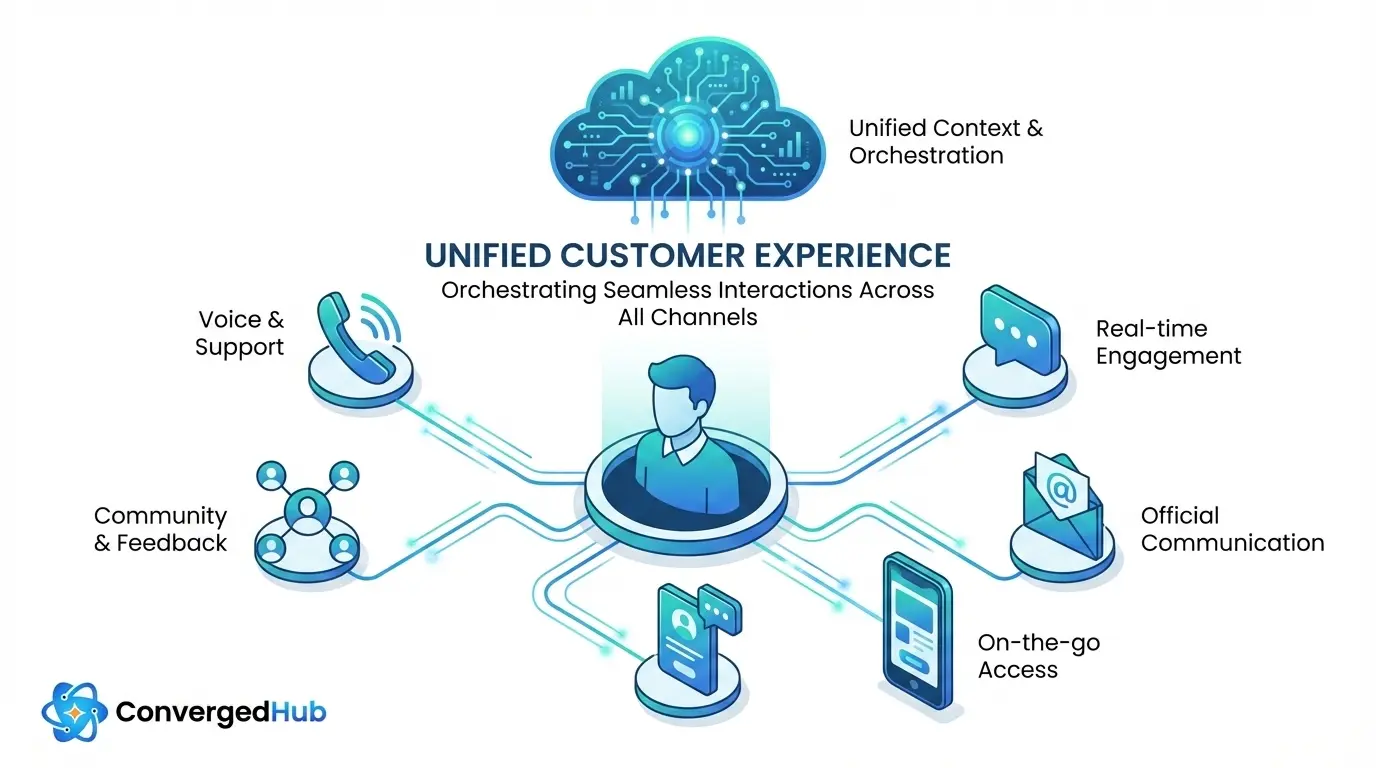
Omnichannel AI CX changes that equation. Instead of parallel, siloed channels, it creates a single, intelligent fabric that remembers who the customer is, why they reached out, and what should happen next — no matter where the interaction started or where it continues.
This article offers a practical, vendor-neutral blueprint for CX, digital transformation, and contact center leaders who are ready to move beyond pilots and buzzwords. You will see how to unify data, context, and orchestration; how AI can make experiences truly channel-agnostic; and how to measure business impact so Omnichannel AI CX becomes a durable enterprise capability, not another short-lived initiative.

Conversational Voice AI – Value Estimator
Quantify the business impact of Conversational Voice AI in minutes.
Use this estimator to:
- Build a data-backed ROI narrative to support executive and board-level decision-making
- Model potential cost savings driven by Voice AI–led call automation and containment
- Quantify productivity gains from reduced agent workload and lower average handle time
- Assess operational efficiency improvements across high-volume voice interactions
Why Omnichannel AI CX Beats Multichannel
Most organizations proudly claim to be ‘multichannel’ because customers can reach them via phone, chat, email, social, or apps. But in practice, these channels are often parallel silos with minimal context carryover, inconsistent policies, and duplicated effort.
In a traditional multichannel model:
- Identity is fragmented – the IVR, chat system, and mobile app all handle authentication differently.
- Context is lost – intents, history, and in-progress tasks rarely follow the customer across channels.
- Policies differ by channel – discounts, scripts, and escalation rules vary, confusing customers and agents.
- Effort multiplies – customers repeat details, agents re-discover information, and operations absorb unnecessary transfers.
Think about a common scenario: a customer starts in web chat about a suspicious transaction. The bot can’t verify identity, so it escalates to voice. The IVR forces re-authentication. The agent who finally answers has no transcript, so they re-ask every question. By the third handoff, the customer abandons and quietly starts browsing competitors.
Research from Harvard Business Review shows that customers judge brands on end-to-end journeys, not isolated touchpoints. Fragmented multichannel CX drives up Customer Effort Score, depresses FCR and CSAT, and creates data blind spots that make improvement guesswork.
Omnichannel AI CX addresses this by treating all interactions as part of a single, persistent journey. Channels become flexible entry and continuation points, not separate experiences. Identity, intent, and policy are shared, so every new touchpoint feels like a seamless continuation instead of a restart.
Inside the Omnichannel AI Stack
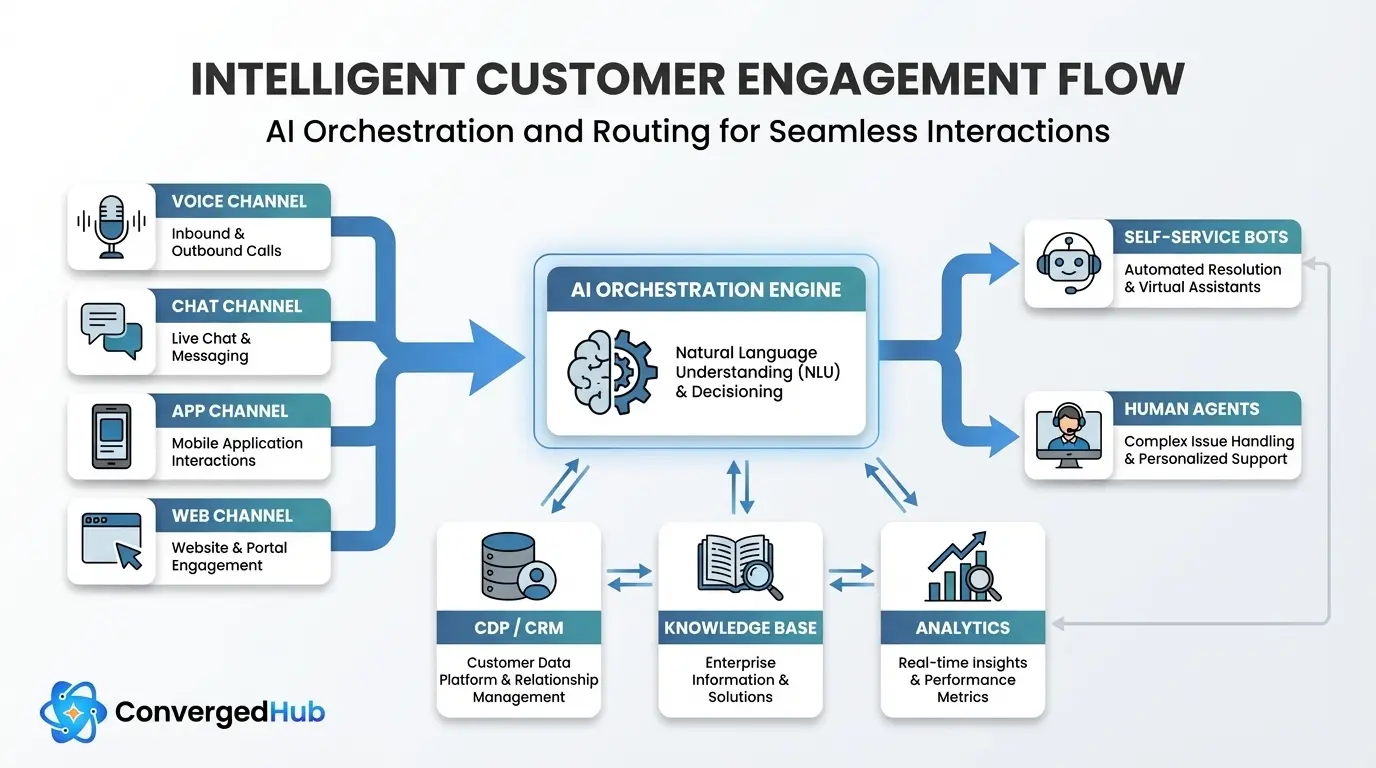
Omnichannel AI CX is more than connecting APIs. It is a unified, AI-driven architecture that persists identity, state, and intent across every interaction while orchestrating next-best-actions in real time.
The Core Building Blocks of Omnichannel AI CX
- Data unification – Create a single source of truth using a Customer Data Platform (CDP) and CRM. Resolve identities across accounts, devices, and channels; centralize consent; and define canonical data contracts so every system speaks the same language.
- Context management – Maintain persistent journey state: current intent, past interactions, preferences, and relevant constraints (eligibility, risk flags, SLAs). This context must be accessible in real time to all channels and services, enabling sessions to pause and resume without loss.
- Orchestration and decisioning – Use an event-driven, policy-aware engine that combines business rules with AI models. It listens to events (a failed payment, negative sentiment, high basket value) and decides the next-best-action: self-serve flow, human handoff, proactive outreach, or no action.
- Conversational AI – Standardize on a shared NLU/NLG layer for both voice and text. Intents, entities, and retrieval-augmented knowledge should be consistent across IVR, voicebots, chatbots, and messaging, with safe-completion policies that respect compliance and brand tone.
- Real-time analytics – Stream interaction data into a real-time analytics layer. Monitor journey progression, QoS, containment, and sentiment; feed insights back into routing, offers, and content in near real time.
When these building blocks are in place, CX leaders can stop stitching together reports channel by channel and instead see — and optimize — a single, converged experience fabric.
Designing Omnichannel AI CX Journeys
True omnichannel isn’t about offering more channels; it is about allowing customers to move fluidly between them without friction. AI is the engine that makes these transitions feel natural and effortless.
Key capabilities include:
- State carryover – When a web chat escalates to voice, the system passes along verified identity, active intent, key entities (order number, account ID), and partial form data. The agent or voicebot begins with ‘I see you’re checking on order #1234 and have already verified your email’ instead of starting from zero.
- Adaptive dialog – Dialog models remember what has already been asked and tailor prompts to each channel. A rich chat can show carousels and quick replies, while the IVR compresses steps into concise, low-latency prompts — without re-collecting the same information.
- Real-time decisioning – The orchestration layer weighs customer value, sentiment, journey stage, risk signals, and current capacity to choose between self-service and assisted service, determine the best channel, and select the best-fit agent or specialized bot.
- Latency-aware experiences – For voice, every millisecond matters. Models are optimized and cached, with edge inference where possible. Graceful fallbacks — such as reverting to a simpler menu or asynchronous follow-up — keep experiences usable even under network stress.
The result is a consistent brand voice and policy footprint, regardless of how customers enter or exit. Behind the scenes, AI resolves the complexity, so the experience feels simple.
Enterprise Use Cases That Win Fast
For CX leaders, the quickest way to build momentum is to target journeys where fragmentation creates visible pain — and where Omnichannel AI CX can show measurable, early wins.
- Cross-channel support journeys – A customer starts in web self-service, gets stuck, and requests help. An intelligent assistant escalates to chat or voice, carrying over identity, knowledge of attempted steps, and error codes. The customer can later continue asynchronously via messaging, with full continuity.
- Proactive engagement – When systems detect shipment delays, billing anomalies, or service outages, event triggers fire proactive messages with embedded self-serve actions (‘Tap here to reschedule delivery’) and swift handoff paths to agents if needed. This reduces inbound volume and prevents churn.
- Personalized interactions – Using CDP and CRM insights, the orchestrator tailors offers, eligibility checks, and scripts to the customer’s segment, behavior, and journey stage. For example, a high-value subscriber with recent complaints receives a retention offer, while a new prospect gets guided onboarding.
- Intelligent routing – Routing decisions factor in skills, language, sentiment, predicted effort, and availability to minimize transfers and maximize FCR. A frustrated VIP caller is not just sent to ‘any agent’ — they are matched to a specialist with the right skills and time to resolve the issue in one interaction.
These use cases demonstrate to business stakeholders that Omnichannel AI CX is not an abstract architecture conversation; it is a direct lever for reducing effort, protecting revenue, and improving loyalty.
Integrations, Metrics, and ROI
Omnichannel AI CX only becomes enterprise-ready when it plugs into the systems that run your contact center and back office. The goal is a closed loop from interaction to insight to improvement.
Critical integrations include:
- Quality and compliance – Automated QA scores every interaction (bot and human) for adherence, empathy, and outcomes. Compliance checks, redaction, and coaching insights feed back into dialog models and playbooks.
- Workforce management (WFM) – Real-time signals from bots and channels improve demand forecasting and intraday staffing. Routing strategies respect capacity, preventing AI from over-committing the human workforce.
- Voice and conversational platforms – A shared intent and knowledge model drives IVR, voicebots, chatbots, and messaging, so content, policies, and responses stay consistent across surfaces.
- Knowledge, ticketing, and RPA – AI retrieves accurate answers from knowledge bases, logs and updates cases in CRM, and triggers robotic process automation for repetitive back-office work such as refunds, entitlement checks, and address changes.
Measuring What Matters
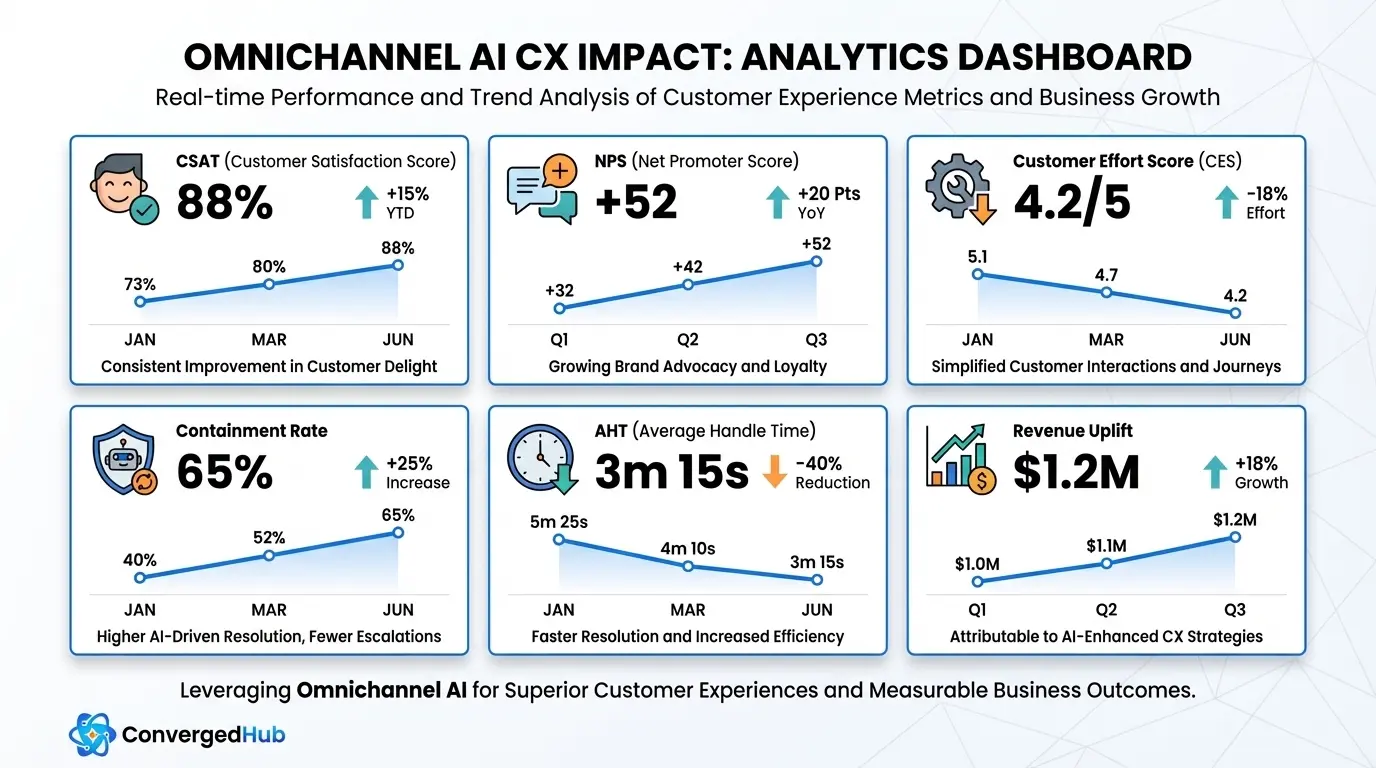
To prove ROI, measure end-to-end journey impact, not just handle time. Key metric families include:
- Customer outcomes – CSAT, NPS, and journey-level metrics such as repeat contacts and Customer Effort Score. Resources like customer experience research highlight how effort predicts loyalty.
- Operational efficiency – Containment and self-service completion rates, AHT, cost-to-serve, transfer rates, agent productivity, and schedule adherence.
- Growth impact – Conversion and upsell rates for AI-assisted journeys, retention and churn reduction from proactive outreach, and revenue per contact.
When these metrics are wired into your analytics and governance routines, Omnichannel AI CX moves from ‘innovation project’ to a core driver of P&L performance.
Roadmap and Governance to Scale
Delivering Omnichannel AI CX at scale is as much about discipline as it is about technology. CX leaders must anticipate challenges and embed governance from the outset.
Common challenges and how to address them:
- Data silos – Define a canonical data schema, enforce data contracts, and implement persistent IDs via your CDP. Ensure every event carries consent, lineage, and purpose tags.
- Integration complexity – Use an event-driven architecture and standard APIs to decouple channels from orchestration. A mediation layer shields channels from back-end changes.
- Latency and reliability – Set SLOs per channel, use model compression and caching (especially for voice), and implement circuit breakers and graceful degradation patterns.
- Privacy, security, and governance – Apply consent-by-purpose, encrypt and minimize PII, maintain audit trails and redaction, and establish model governance with human oversight.
- Model risk – Use prompt and response guardrails, safe fallbacks to humans or simpler flows, bias monitoring, and continuous evaluation against golden datasets.
Practical Implementation Stages
- Stage 1 – Assess and align – Map priority journeys, identify high-effort moments, inventory data and systems, define KPIs, and agree on governance.
- Stage 2 – Pilot and prove – Launch 1–2 cross-channel journeys (for example, order status or password reset). Rigorously measure CES, FCR, and latency.
- Stage 3 – Scale and standardize – Expand intents, unify knowledge, industrialize orchestration, integrate QA/WFM, and codify policies and content standards.
- Stage 4 – Optimize and automate – Add proactive triggers, real-time decisioning, richer agent assist, and continuous A/B testing with closed-loop analytics.
Best-Practice Guardrails
- Design for continuity: no dead ends, clear recovery paths, and visible progress.
- Practice channel-righting: let customers choose, but gently steer them to the most effective channel for their intent and your capacity.
- Measure total effort minutes and outcome quality, not just handle time or containment rate.
- Govern content and models with versioning, approval workflows, and drift detection.
- Equip agents with context-rich desktops, suggested actions, and coaching insights so human touchpoints remain exceptional.
With this roadmap, Omnichannel AI CX becomes an iterative capability you can scale confidently, rather than a risky ‘big bang’ transformation.
Omnichannel AI CX transforms fragmented touchpoints into a single, intelligent customer journey that feels effortless to the customer and controllable to the enterprise. By unifying data, sharing context, and orchestrating next-best-actions across every channel, organizations can simultaneously reduce effort, lift satisfaction, and improve efficiency.
The winning strategy is deliberate: start with high-friction journeys, prove measurable impact, industrialize the architecture, and embed strong governance. Done well, Omnichannel AI CX becomes a durable competitive advantage — enabling your brand to deliver seamless, intelligent experiences everywhere your customers are.