
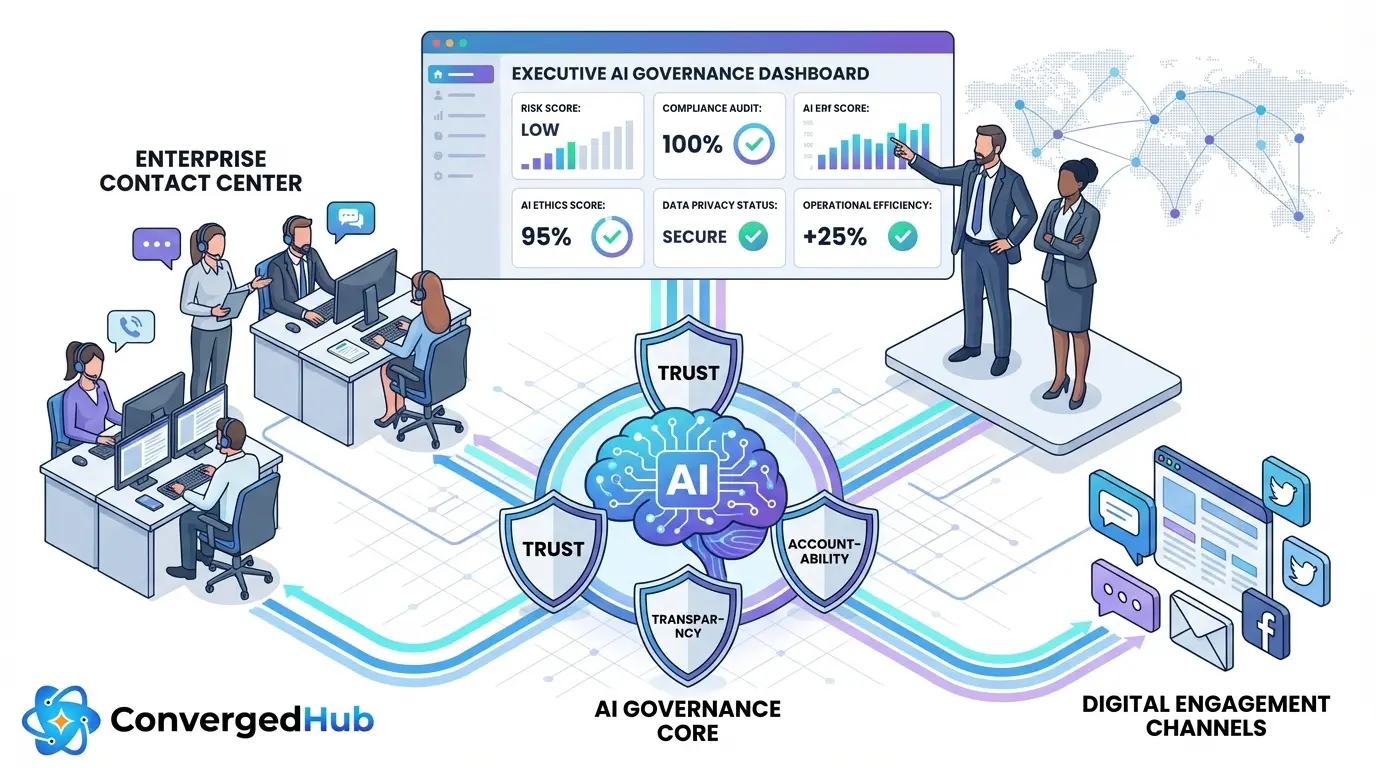
Gen AI is no longer a lab experiment in customer experience. Voice bots, chat interfaces, and agent assist copilots now sit between your brand and millions of daily customer moments. The upside is enormous, but so is the blast radius when an ungoverned model hallucinates, discriminates, or mishandles sensitive data.
For CX leaders, digital transformation owners, and risk and compliance teams, the real question is no longer whether to use AI, but whether customers, regulators, and your own frontline teams can trust the way AI shows up in every interaction.
This article defines what Responsible AI in CX really means at enterprise scale and translates ethics and governance into practical controls. You will see how to reduce risk without stalling innovation, building a CX AI stack that is transparent, auditable, and accountable by design.

AI Readiness Maturity Scorecard
Use this scorecard to:
- Assess your organization’s current readiness across strategy, data, technology, people, and governance
- Identify capability gaps that could limit the success of AI and automation initiatives
- Evaluate alignment between business objectives, operating models, and AI adoption plans
- Benchmark maturity across key dimensions required for scalable AI transformation
- Prioritize investments needed to move from experimentation to enterprise-wide AI impact
- Build a clear, actionable roadmap for advancing AI readiness with measurable milestones
Why Trust Defines AI Powered CX
AI now touches almost every stage of the customer journey. Enterprises deploy conversational AI in IVRs, chat, messaging, and kiosks; agent assist in contact centers; and workflow automation across back office journeys. McKinsey estimates that generative AI could add trillions in value, much of it in customer operations and sales.
Yet the same models that unlock efficiency also introduce a new class of risk. A single hallucinated answer about a billing dispute, medication, or eligibility decision can create regulatory complaints, social media backlash, and erosion of brand trust.
From Pilots to Production
Many CX teams still treat AI as an experiment. Proof of concepts are green lit based on speed and excitement, while risk, compliance, and legal review lag behind. As usage scales across channels and regions, ad hoc decisions become dangerous.
Trust becomes the primary constraint. Without clear guardrails, boards and regulators will force programs to slow or unwind. With a responsible AI foundation, however, CX leaders can scale automation and intelligence with confidence, knowing that each new use case sits inside a controlled and observable system.
Defining Responsible AI in CX
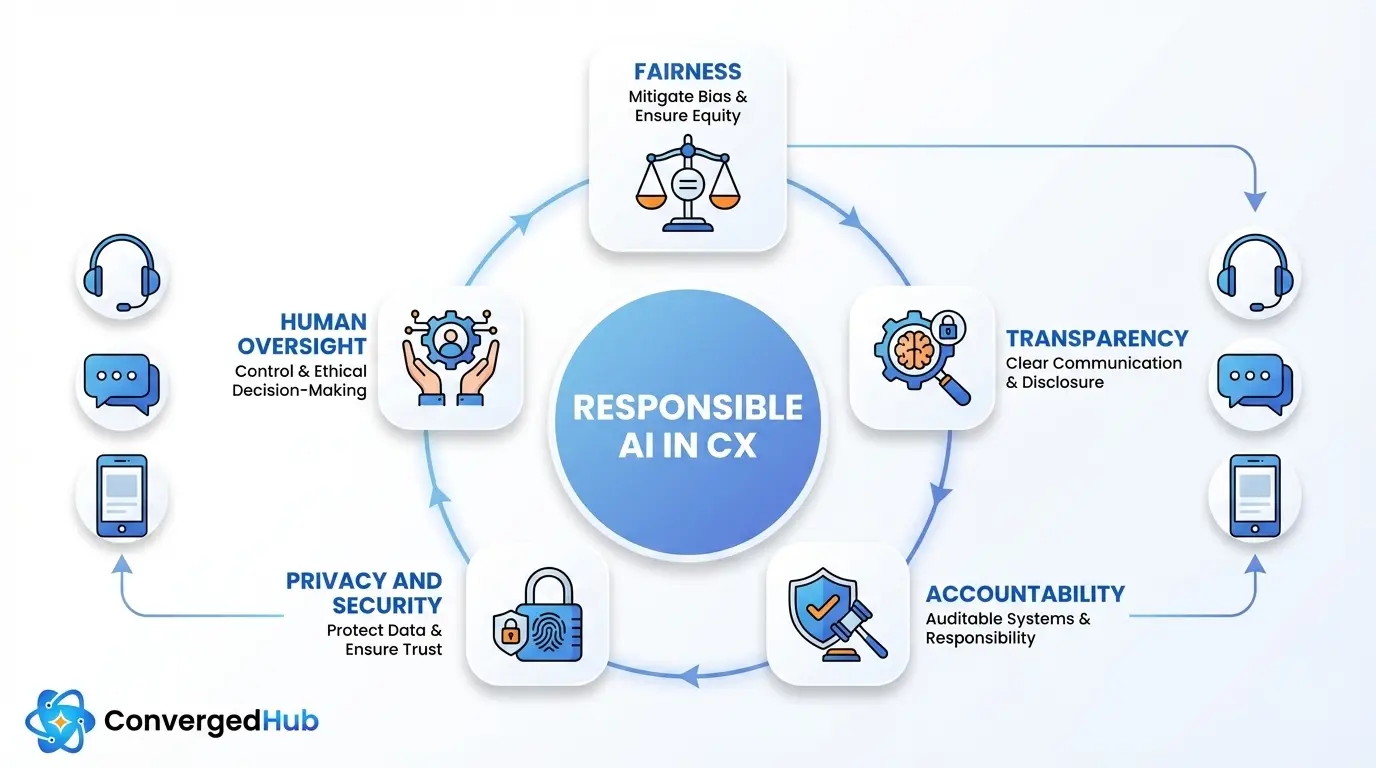
Responsible AI in CX is not a slogan. It is a disciplined way of designing, deploying, and governing AI so that customer facing systems are lawful, fair, transparent, secure, and subject to human judgment.
It builds on widely accepted frameworks such as the OECD AI Principles and the NIST AI Risk Management Framework, translated into CX specific practices.
Core principles, in CX language
- Fairness: Models should not produce systematically worse outcomes for protected groups. In CX this includes credit offers, collections strategies, complaint handling, and priority routing.
- Transparency: Customers and agents should understand when they interact with AI, what it does, and how to challenge or bypass it.
- Accountability: Clear ownership for each AI system across CX, IT, risk, and vendors, including documented approvals and escalation paths.
- Privacy and security: Strong controls over what customer data is collected, how it is used for training and inference, where it is stored, and how long it is retained.
- Human oversight: For high impact decisions, humans remain in control. AI augments, recommends, and flags, but does not replace human judgment for sensitive edge cases.
Responsible AI in CX therefore means embedding these principles into design templates, procurement checklists, contact center workflows, and daily performance reviews, not just policy slide decks.
Risks Across the AI Customer Journey
Once AI sits between your brand and your customers, risks shift from abstract to very concrete. The most common issues show up not as model failures in a lab, but as broken customer promises in live journeys.
Key risk categories
- Bias and disparate impact: Training data that reflects historical bias can lead to unfair treatment in offers, collections, complaint handling, or fraud flags. Disparate outcomes across age, gender, language, or geography can quickly become regulatory exposure.
- Hallucinations and misinformation: Generative models sometimes fabricate answers with high confidence. In CX that can mean false policy statements, incorrect fees, misleading eligibility information, or unsafe product advice.
- Regulatory non compliance: Missteps related to consent, marketing claims, credit decisions, or handling of health data can violate laws overseen by bodies such as the US Federal Trade Commission or under regional regimes like the emerging EU AI Act.
- Channel inconsistency: If voice, chat, and human agents rely on different logic or models, customers receive conflicting answers about fees, limits, or entitlements. This undermines trust and complicates compliance audits.
- Automation overreach: Over eager automation may remove necessary human review from billing disputes, cancellations, vulnerable customers, or fraud cases, leading to reputational harm and regulatory scrutiny.
Responsible AI in CX starts by mapping where these risks can appear in journeys, and then specifying guardrails before a single line of integration code is written.
Governance, Policy, and Oversight
An enterprise cannot manage AI risk with one off approval emails. You need an operating model that treats AI systems like regulated products, with clear lifecycle controls and shared accountability.
Risk tiering for CX use cases
Start by categorizing AI use cases by business impact and harm potential. For example:
- Tier 1 high risk: Decisions about eligibility, pricing, collections, cancellations, vulnerable customers, or health and financial advice.
- Tier 2 moderate risk: Conversational self service for general inquiries, next best action suggestions to agents, sentiment analysis.
- Tier 3 lower risk: Internal productivity tools, summarization of calls for notes, basic routing recommendations.
Higher tiers require stricter approvals, testing, oversight, and human in the loop controls.
Model lifecycle governance
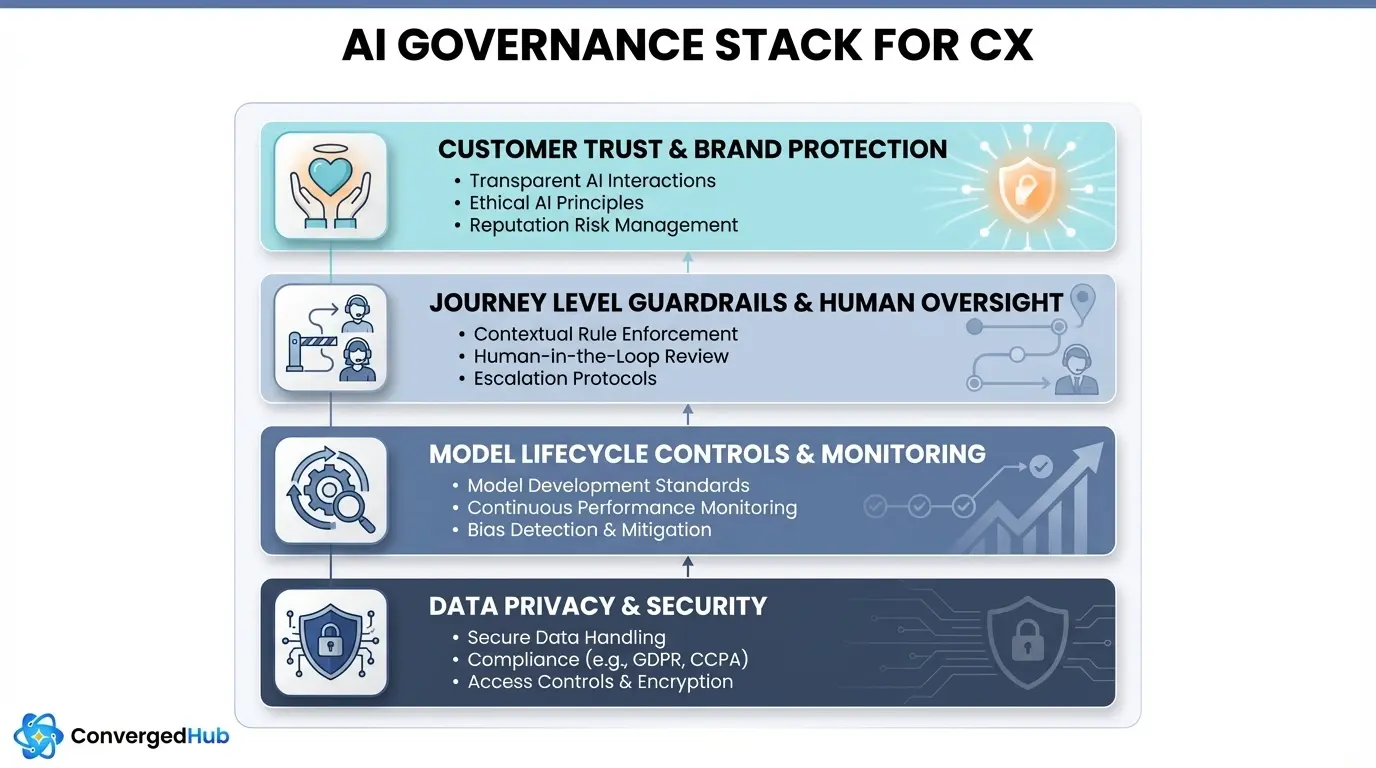
For each CX AI system, define controls from initial idea through retirement:
- Design: Document purpose, risk tier, target customers, and success metrics. Capture data sources, vendors, and known limitations.
- Build and test: Use red teaming, diverse test data, and scenario based evaluation. For generative AI, test prompt variations, jailbreak attempts, and safety filters.
- Deploy: Use canary releases, rate limits, and clear kill switches owned by CX and risk leaders.
- Monitor and update: Track performance, incidents, and drift; require periodic re approval for major model or policy changes.
A cross functional RACI across CX, data science, IT, legal, and compliance clarifies who owns which decisions. Maintain an AI risk register documenting systems, risks, mitigations, and incidents. Pre defined incident response playbooks should cover rollback, customer communication, and regulatory notifications when needed.
Data, Privacy, and Safe Automation
Customer trust in AI is impossible without rigorous data protection. Responsible AI in CX requires that every new model and workflow respects privacy by design and by default.
Data minimization and consent
Collect and process only the data needed for a specific CX purpose, and be explicit with customers about that purpose. Align with standards such as the European Union General Data Protection Regulation described at GDPR.eu.
- Apply purpose limitation: do not reuse customer transcripts or logs for unrelated training without explicit consent.
- Use PII redaction for voice and chat before data is stored or sent to external AI providers.
- Coordinate consent orchestration across channels so that opt outs are honored consistently in IVR, chat, email, and human assisted journeys.
Guardrails for CX AI use cases
Each class of CX AI system needs specific controls:
- Conversational AI and voice AI: Implement prompt hygiene, allow only approved system prompts, and enforce safety filters that block disallowed topics or responses. Limit free form model access to sensitive back end systems.
- Agent assist: Use confidence thresholds and allow agents to accept or edit suggested actions instead of auto executing them. Log overrides to identify patterns where the model is misaligned with policy.
- Workflow automation: Make workflows policy aware with explicit checks before executing high impact actions like fee waivers or account closures. Include mandatory approval steps for Tier 1 scenarios.
These controls keep automation powerful but predictable, so customers experience AI as a reliable extension of your brand, not an opaque black box.
Metrics, Monitoring, and a 90 day plan
Without measurement, responsible AI in CX remains an aspiration. You need metrics that reveal both value and risk so that leaders can steer, not just observe.
Responsible AI KPIs for CX
Combine traditional CX and operational metrics with AI specific indicators, such as:
- Quality and safety: Hallucination or guardrail violation rate, policy breach detections in transcripts, and override or escalation rates from agents.
- Fairness and consistency: Outcome parity across demographics, languages, and channels; consistency scores for answers between AI and human channels.
- Privacy and compliance: Consent accuracy, privacy incident rate, audit trail completeness, and retention compliance.
- Trust signals: Complaint rate, dispute reversals, repeat contact on the same issue, and satisfaction for AI assisted interactions versus control groups.
Integrate these into existing QA programs. Use automated transcript scanning, pre production test suites, canary deployments, drift detection, and live policy enforcement so that issues surface early.
A Pragmatic 30-60-90 Day Roadmap
- First 30 days: Inventory CX AI use cases, classify them by risk tier, identify data flows, and stand up an AI steering group with CX, IT, and risk representation.
- Next 60 days: Define standard design templates, approval gates, and monitoring dashboards for high and moderate risk use cases. Pilot human in the loop patterns and updated QA scorecards on a small set of journeys.
- By 90 days: Operationalize the governance model across vendors and business units, close the highest priority gaps in data protection and consent, and publish an internal Responsible AI in CX playbook so teams have a repeatable blueprint.
From there, treat responsible AI as an ongoing program, not a project, with continuous learning from incidents, audits, and customer feedback.
AI will soon underpin nearly every customer interaction, from first contact to collections. The question is whether that intelligence operates inside a framework of trust, transparency, and accountability, or as a patchwork of risky experiments.
By defining Responsible AI in CX clearly, embedding governance and data protections, and tracking the right metrics, CX leaders can scale automation and intelligence without sacrificing ethics or compliance. The result is not only lower risk, but a differentiated customer experience where AI is dependable, contestable, and aligned with your brand values.