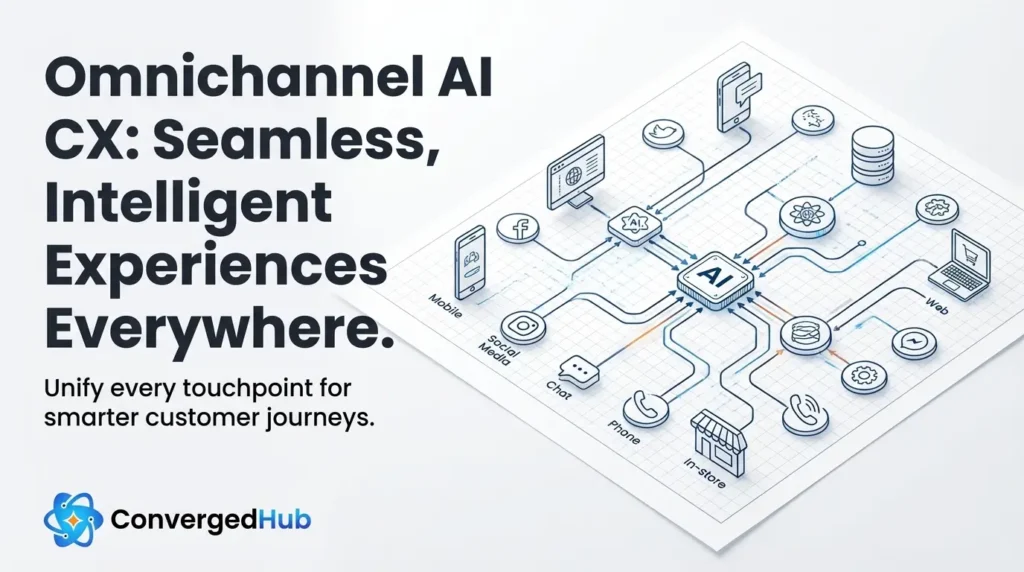

Contact volumes are no longer just peaks and valleys on a spreadsheet. They are live expressions of customer intent moving fluidly across voice, chat, and messaging. For CX and Digital leaders, the real unlock is not simply forecasting volume, but predicting why customers reach out, how complex each intent is, and which interactions should be handled by bots versus humans in real time.
This is where modern call center WFM tools are heading. Workforce Management 2.0 blends AI forecasting, intent analytics, and converged channel data to orchestrate the right mix of agents and automation every minute of the day. In this guide, we explore how LLM powered forecasting reshapes staffing, which capabilities to look for, and how to run a 90 day pilot that proves measurable impact.

Conversational Voice AI – Value Estimator
Quantify the business impact of Conversational Voice AI in minutes.
Use this estimator to:
- Build a data-backed ROI narrative to support executive and board-level decision-making
- Model potential cost savings driven by Voice AI–led call automation and containment
- Quantify productivity gains from reduced agent workload and lower average handle time
- Assess operational efficiency improvements across high-volume voice interactions
From intervals to intents
Traditional WFM assumes that if you know how many contacts will arrive in a 30 minute interval, you can staff to a service level target. That made sense when most interactions were voice calls with relatively consistent handle times.
Today, customers start in self service, bounce to webchat, escalate to voice, and continue on email or messaging. A single journey may span hours or days, with different complexity at each step. Treating this as one generic contact type forces CX leaders to overstaff and still miss expectations.
WFM 2.0 shifts from interval based thinking to intent based planning. Instead of forecasting 10,000 chats on Monday, you forecast 10,000 interactions broken down into intents such as billing dispute, password reset, or outage inquiry, each with its own channel mix and handle time profile.
LLM driven analytics can automatically classify intents from transcripts and chat logs, revealing patterns like:
Which intents your bots can contain fully
Which intents always escalate to voice
Which intents have highly variable handle times
This gives CX and Transformation leaders an operational lens that finally matches journey design: staffing, automation, and routing all organized around customer intent rather than generic queues.
How AI forecasting works
Modern AI forecasting in call center WFM tools starts with rich telemetry, not just interval counts. Large language models and intent classifiers ingest:
- Historical call recordings and transcripts
- Chat and messaging logs
- Bot conversations and containment outcomes
- CRM events such as orders, claims, and outages
From this, the system learns patterns at an intent and channel level, such as:
- Expected handle time ranges for each intent by voice, chat, and async messaging
- Probability that a bot will contain or transfer a given intent
- Channel hopping sequences, for example webchat to voice within 10 minutes
- Concurrency profiles for digital agents, for example handling 2.5 chats in parallel on average
Instead of a single AHT per queue, you get distributions per intent and channel. This allows more accurate simulation of staffing needs, especially for chat and messaging where concurrency varies. References such as the McKinsey perspective on the future of customer care highlight the value of these granular insights for digital contact centers (see McKinsey).
When you overlay promotional calendars, product launches, or seasonality, AI models can anticipate intent shifts, for example more onboarding questions after a pricing change. The result is a living forecast that stays aligned to business events, not just historic volumes.

An intent level KPI stack
To get value from AI driven WFM, CX leaders need metrics that reflect intents, channels, and automation. A generic average handle time hides the story. A modern KPI stack should include:
- SLA by intent and channel – For example, 80 percent of outage chats answered in 30 seconds versus 80 percent of password reset calls in 60 seconds. This lets you protect high risk intents without overstaffing everything.
- AHT distribution and variance – Understanding the spread of handle times per intent helps you target training, knowledge content, or automation where it matters most.
- Occupancy and shrinkage – Still critical, but now analyzed by skill group and channel mix so you do not overload digital agents with unrealistic concurrency targets.
- Bot containment and transfer rates – Measured by intent, so you can see which journeys are over escalating to humans and where LLM powered bots could safely do more. Resources such as Google Cloud Contact Center AI provide examples of measuring assist and containment impact (Google Cloud).
- Cost to serve by intent – Incorporating labor, technology, and rework to spotlight high cost journeys.
Once these metrics are tied into your WFM platform, you can simulate the impact of changing containment targets or channel mix. For example, how many fewer agents you would need on a holiday weekend if you move 15 percent of billing calls into proactive self service alerts.
Unifying data for WFM 2.0
AI forecasting is only as good as the data foundation under it. Most enterprises still have fragmented streams across CCaaS, CRM, and bot platforms. The first step is to unify bot and human telemetry into a single, time aligned view of the customer journey.
Typical sources include:
- Contact center platforms such as Genesys, Amazon Connect, or Five9
- CRM systems such as Salesforce or Microsoft Dynamics capturing case and customer data
- Bot platforms handling chat, voice IVR, or in app messaging
- Quality and interaction analytics tools with transcripts and sentiment
Your goal is a normalized schema where each interaction has:
- Intent label and confidence score
- Channel and device
- Start and end timestamps, including transfer chains
- Bot versus agent handling indicators
- Outcome codes and journey identifiers
Gartner describes this as a cornerstone of broader Workforce Engagement Management, where analytics and WFM share a data spine (Gartner WEM).
Data governance is critical. Define who owns intent taxonomies, how you anonymize sensitive fields, and what latency you need for intraday updates. For real time staffing and dynamic routing, you typically need data latency measured in minutes, not days.

Choosing AI ready WFM tools
When evaluating next generation call center WFM tools, look beyond classic features and focus on how well they understand intents, automation, and converged channels. Key capabilities include:
- Dynamic intraday automation – The system should adjust forecasts and staffing plans during the day based on live arrival and containment data, not just nightly batch runs.
- Skill and intent aware scheduling – Schedules must align not just to queues, but to intent clusters and proficiency levels. For example, reserving specific agents for high risk regulatory or VIP intents.
- Concurrency aware planning for digital – Models that understand realistic chat and messaging concurrency per intent and time of day, rather than fixed multipliers.
- Real time adherence and assist – Combining adherence data with AI insights so supervisors can see which skills or intents are under stress and offer targeted coaching or AI assist.
- Native integrations with CCaaS and CRM – Direct connectors into your cloud contact center and CRM reduce data engineering overhead and enable faster pilots.
Vendors that embed LLMs for forecasting and scenario planning should also offer clear controls, including the ability to adjust intent groupings, override forecasts, and see explanations for major changes. Explainability builds trust with workforce planners who must defend staffing decisions to finance and operations.
Pilot plan and vendor checklist
To de risk adoption, run a 90 day pilot that targets a specific, measurable problem such as peak season coverage or outage handling.
Suggested 90 day timeline
- Weeks 1 to 3: Define scope. Choose 3 to 5 high value intents across voice and chat, confirm KPI baselines, and align with finance on how savings will be measured.
- Weeks 4 to 6: Connect data. Integrate CCaaS, CRM, and bot telemetry. Validate intent labeling and handle time distributions with operations leaders.
- Weeks 7 to 10: Configure WFM. Turn on AI forecasting for pilot queues, set intraday automation rules, and run in shadow mode against your current process.
- Weeks 11 to 13: Go live for a defined window such as a marketing campaign or known seasonal peak. Act on AI recommendations for staffing, overtime, and proactive self service.
- Week 14: Compare results on SLA by intent, occupancy, shrinkage, containment, and cost to serve.
Vendor due diligence checklist
- Data governance – How is data stored, anonymized, and retained Are regional data residency needs supported
- Explainability – Can planners see why a forecast changed, which signals were used, and test alternative scenarios
- Edge case handling – How does the system behave during black swan events such as nationwide outages Is there a safe manual override
- Model lifecycle – How often are models retrained, and can you include new intents or channels without a major project
- Open integrations – Does the vendor support standard APIs and webhooks so you can connect to existing analytics and reporting tools
When you frame the pilot around concrete business events and a clear KPI set, it becomes much easier to secure sponsorship and to expand WFM 2.0 from a few queues to your entire contact center network.
AI infused WFM is not about replacing planners. It is about giving CX and Digital leaders a richer, intent level view of demand so they can orchestrate agents and automation with confidence. By unifying bot and human data, choosing WFM tools that understand converged channels, and running a focused 90 day pilot, you can turn forecasting from a backward looking report into a proactive lever for customer experience and cost.
The organizations that move first will be the ones that sail through marketing spikes, outages, and new product launches while competitors struggle with long queues and frazzled agents. Call center WFM tools 2.0 are ready. The question is whether your operating model is.