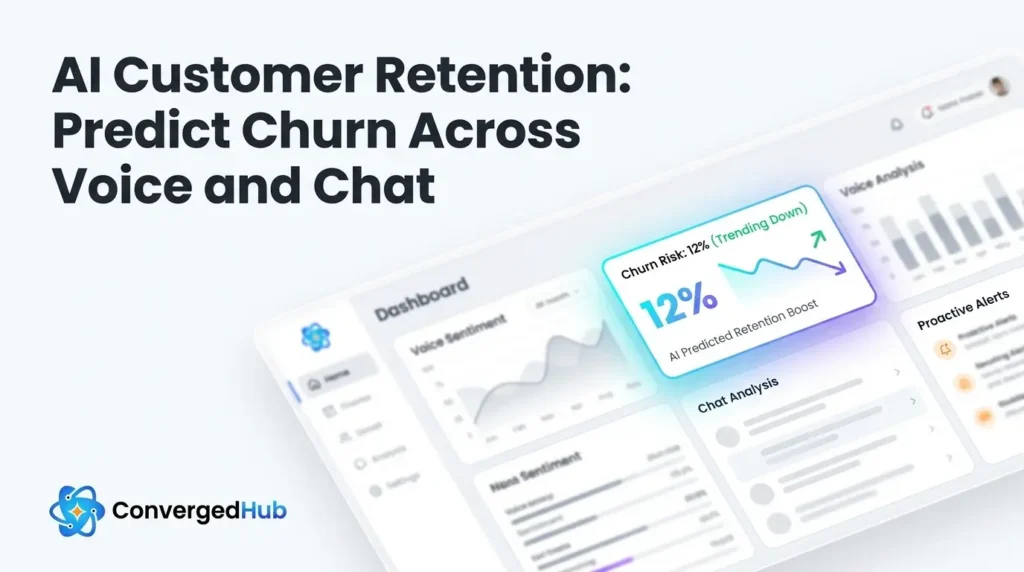

In most enterprises, the richest data set for customer experience sits in cold storage: terabytes of call recordings that no one has time to listen to. Meanwhile, your teams debate why churn is creeping up, why self service stalls, and why agents struggle to follow an ever changing playbook.
Modern voice analytics turns every second of conversation into structured signals in real time. Instead of treating calls as a compliance archive, you can use live intent, sentiment, and outcome data as a control plane that guides human agents, AI agents, and CX strategy in one loop.
This guide is written for CX and Digital Transformation leaders who want more than another reporting dashboard. You will see how a converged voice analytics layer can orchestrate agent assist, automated quality assurance, and large language model tuning, how to launch in ninety days, and how to prove hard ROI to your finance leaders.

The CX Leader’s AI Implementation Playbook
The CX Leader’s AI Implementation Playbook is your step-by-step guide to navigating the AI revolution in customer experience. With practical frameworks, industry spotlights, and proven strategies, it gives you the roadmap to build the business case, design credible pilots, scale responsibly, and deliver measurable ROI in the next 100 days and beyond.
From Call Recordings to Control Plane
In many organizations, voice analytics for contact centers has been treated as a nice to have reporting add on. A vendor installs speech analytics, a team gets a weekly keyword report, and then little in the operating model actually changes. The result is low voice analytics ROI and an understandable skepticism from senior leaders.
The breakthrough comes when you reframe voice analytics as your CX control plane rather than as a reporting tool. The control plane continuously listens across every interaction, understands why customers are calling, detects emotion and friction, and then orchestrates the next best action across human and AI channels.
When used this way, the voice analytics benefits extend far beyond compliance and handle time:
- Product and policy teams see in near real time which changes are confusing or failing in the field.
- Supervisors get precise coaching opportunities tied to actual behaviors, not anecdote or random sampling.
- Digital teams see which intents should be diverted to bots, apps, or proactive outreach instead of expensive calls.
Research from Harvard Business Review shows that consistent, well managed journeys can significantly increase customer loyalty and reduce churn. Voice analytics gives you the continuous, high fidelity view of those journeys that traditional surveys cannot provide, making it a practical foundation for transformational CX programs as this analysis explains.
Inside Modern Voice Analytics
Under the hood, modern voice analytics is a pipeline that converts unstructured audio into structured events that machines and humans can act on in real time.
- Speech recognition converts raw audio into time stamped text using domain tuned acoustic and language models. Cloud services such as Google Cloud Speech to Text illustrate how far accuracy and latency have advanced in the past few years as their documentation shows.
- Speaker diarization separates customer and agent channels so that you can analyze talk ratios, interruptions, and silence patterns.
- Natural language understanding detects intents, key entities such as account type or product, and topics like billing dispute or outage report.
- Paralinguistic models infer sentiment and emotion from tone, pace, and energy to flag frustration, confusion, or relief even when customers use polite language.
- Outcome and compliance models connect what was said to what happened, such as churn save, sale, or escalation, and whether mandatory disclosures, authentication, or scripts were completed.
The same pipeline can run in batch mode for large scale analytics and in streaming mode for live conversations. When you combine both, you gain a feedback loop where historical data improves models, and real time insight steers every interaction while it still matters.

Reference Architecture in Practice
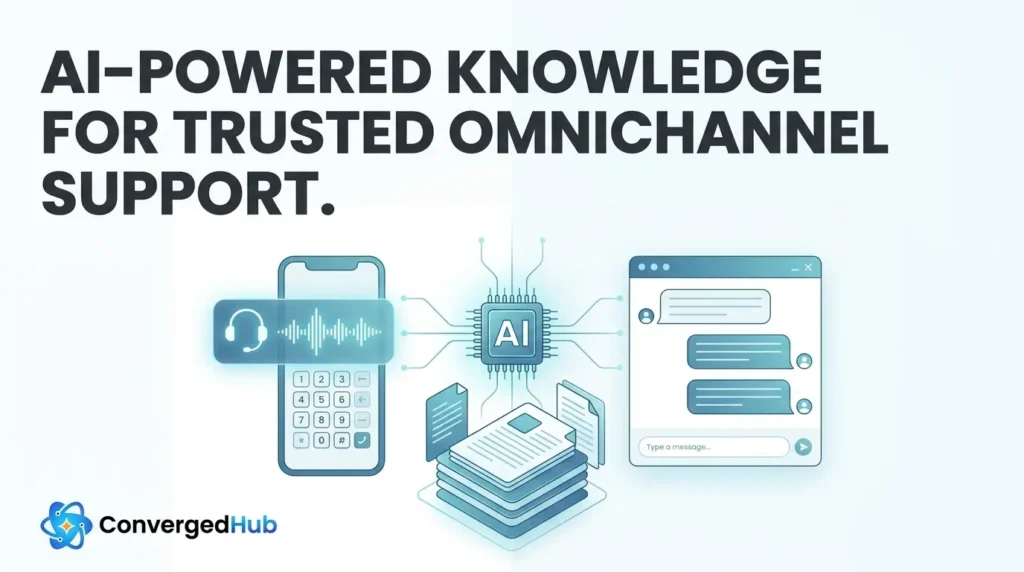
To act as a true CX control plane, voice analytics needs to sit at the center of your contact center and digital ecosystem, not at the edge. A practical reference architecture has four layers that connect telephony, agent desktops, CRM, and AI services into one feedback system.
- Ingestion and streaming: Audio streams flow from your contact center platform, softphones, and voice bots into a scalable stream processing layer. Here calls are tagged with channel, queue, and customer identifiers while they are still in progress.
- Real time understanding: The speech to intent pipeline runs per stream, producing transcripts, detected intents, sentiment, and compliance signals with second level latency.
- Event bus and data store: All analytic signals are published as events on a secure bus and persisted in a warehouse or lakehouse. This is where you can join voice data with CRM fields, marketing campaigns, and product data.
- Downstream applications: Multiple consumers subscribe to the event stream, including agent assist interfaces, automated QA scoring, case summarization, LLM prompt tuning, and executive CX dashboards.
Because every interaction produces a consistent stream of intents, outcomes, and risk signals, you can orchestrate both human and AI agents from the same intelligence layer. For example, if the system detects a high risk complaint early in a call, it can alert a supervisor, suggest retention offers to the agent, and update the next best action that your digital channels use for similar intents.
A 90-Day Rollout Blueprint
One reason voice analytics projects stall is that leaders try to design the perfect future state before proving value. A focused ninety day rollout is enough to validate the control plane approach and build momentum with frontline teams.
Days 0 to 30: Baseline and taxonomy
- Select one or two high impact use cases such as retention saves, technical support, or collections. Quantify baseline metrics for containment, first contact resolution, average handle time, and CSAT.
- Define an intent and outcome taxonomy that spans voice and chat, so that the same customer reason code appears regardless of channel.
- Configure call routing, recording, and transcription for the chosen queues, taking care of access controls and data retention policies.
Days 31 to 60: Pilot with one queue
- Turn on real time transcription and intent detection for a single queue or line of business.
- Expose supervisors and a small group of agents to live dashboards that show intents, sentiment swings, and compliance alerts during or immediately after calls.
- Hold weekly or even daily stand ups where operations leaders review patterns and agree on specific experiments, such as a new opening script or updated troubleshooting flow.
Days 61 to 90: Scale to coaching and AI tuning
- Expand coverage to additional queues while introducing automated QA scoring and suggested coaching clips based on detected behaviors.
- Feed summarized transcripts and labeled intents into your LLM based assistants so that prompts and knowledge articles reflect real customer language and objections.
- Publish a ninety day impact review that ties voice analytics to hard outcomes such as reduced repeat contacts, improved QA coverage, and faster ramp for new agents.
By the end of this window, you have a working CX control plane for at least one segment, real data on voice analytics ROI, and a playbook for scaling to the rest of the operation.

CX Control-Plane Operating Model
Technology alone will not turn voice analytics into a durable CX control plane. You also need an operating model that governs how data is handled, how models are monitored, and how humans stay in the loop.
- Data governance and privacy: Define which roles can access raw audio, transcripts, and derived features. Implement automatic redaction of payment card numbers and sensitive personal data, set retention policies by region, and document how the system complies with regulations such as GDPR and industry standards like PCI DSS.
- Model lifecycle management: Track accuracy and drift for speech recognition, intent, sentiment, and compliance models. Establish a cadence for retraining with recent data, and maintain a clear approval process before new models are promoted to production.
- Human in the loop review: Give QA leaders and supervisors tools to review model outputs, override scores, and flag misclassifications for retraining. This feedback loop stabilizes performance and builds trust on the floor.
Major AI providers emphasise the need for responsible AI practices that balance innovation with fairness, privacy, and transparency, as Microsoft outlines in its responsible AI principles on its site. Applying those principles to voice analytics helps you engage legal, risk, and compliance stakeholders as allies rather than blockers.
KPIs and the Maturity Journey
Voice analytics becomes strategic when it is tied to a short list of hard metrics that both CX and finance leaders care about. At minimum, your control plane should track the following KPIs by queue, segment, and intent.
- Containment rate: The percentage of intents resolved in self service or automation without reaching an agent.
- First contact resolution: The percentage of issues resolved in a single interaction, across voice and chat.
- Average handle time: Tracked alongside resolution and sentiment, so that speed gains do not mask worse outcomes.
- CSAT and NPS: Tied back to intents, journeys, and specific behaviors such as empathy statements or proactive education.
- QA coverage and coaching velocity: The share of interactions that are auto scored, and the time from issue detection to completed coaching session.
- Compliance risk index: Frequency and severity of missed disclosures, policy violations, and escalation failures.
As you mature, the analytics layer evolves from reactive reporting to proactive and then autonomous orchestration:
- Level 1: Reactive insights after the fact, manual coaching, limited automation.
- Level 2: Assisted real time alerts and agent assist, partial QA automation.
- Level 3: Predictive early warning on churn and complaints, dynamic routing based on risk and value.
- Level 4: Autonomous cross channel orchestration where the system continuously tunes bot flows, knowledge content, and coaching plans based on live signals.
The same framework applies across converged voice and chat experiences. Once you share a taxonomy and analytics layer, you can see how intents move between channels, understand where automation genuinely helps, and design journeys that respect customer preferences while protecting margins.
Voice interactions remain the most emotionally charged and operationally expensive moments in your customer journey. With a modern voice analytics layer acting as your CX control plane, those moments stop being a black box and become a continuous stream of guidance for human and AI teams.
By starting with a focused ninety day rollout, building a clear operating model, and steering by hard KPIs, you can move quickly from scattered reports to predictive coaching and autonomous orchestration. Along the way, you unlock voice analytics benefits that compound across product, digital, and service functions.
Platforms such as ConvergedHub.AI are designed to provide this converged intelligence across voice and chat, so that automation, agents, and leaders all work from the same source of truth. The real question is no longer whether you can afford to invest in voice analytics for contact centers, but how long you can afford to keep running without a control plane for your most important conversations.