In most contact centers, burnout shows up first as a mystery spike in average handle time, a drift in CSAT, or an agent who suddenly goes from top quartile to performance plan. By the time HR metrics confirm the trend, the damage to customer experience, team morale, and budgets is already done.
Modern qa software burnout detection changes that timing. By mining live conversation data across voice and digital channels, it surfaces early, objective signals of strain that traditional surveys and observational QA miss. For CX, Digital Transformation, and Innovation leaders, this is not a wellness side project. It is a new control layer in call center quality assurance software that directly protects revenue, brand, and talent.
This article breaks down how conversation analytics can expose hidden burnout risk, how to operationalize insights across QA and WFM, and how to roll out these capabilities responsibly in a 90 day horizon.

The CX Leader’s AI Implementation Playbook
The CX Leader’s AI Implementation Playbook is your step-by-step guide to navigating the AI revolution in customer experience. With practical frameworks, industry spotlights, and proven strategies, it gives you the roadmap to build the business case, design credible pilots, scale responsibly, and deliver measurable ROI in the next 100 days and beyond.
Burnout as a CX system risk
Burnout in contact centers is no longer only an HR concern. It is a system level CX risk that shows up in every operational metric leaders care about.
Research from Gallup links burnout to higher absenteeism, lower productivity, and greater turnover. The World Health Organization now classifies burnout as an occupational phenomenon, with measurable impact on performance and health.
In a contact center, that translates into:
- CSAT and NPS erosion: emotionally drained agents have less capacity for empathy, active listening, or creative problem solving, even when they follow the script.
- FCR decline: tired agents push for quicker closure, miss context, and generate repeat contacts that inflate volume and cost.
- AHT variance: some agents rush to exit calls, others stall or get stuck, widening handle time bands and breaking staffing models.
- Compliance risk: fatigue increases error rates on mandatory disclosures, verification, and regulated scripts.
- Attrition and replacement cost: replacing a single tenured agent can cost 20 to 30 percent of annual salary when you include hiring, training, and ramp.
Hybrid work, constant policy changes, and omnichannel complexity compound the problem. Agents juggle voice, chat, messaging, and email while navigating evolving journeys and systems. Cognitive load is rising faster than traditional supports can keep up. Without automated burnout detection inside your QA stack, many of the most at risk agents remain invisible until they resign or fail.
Why legacy monitoring fails
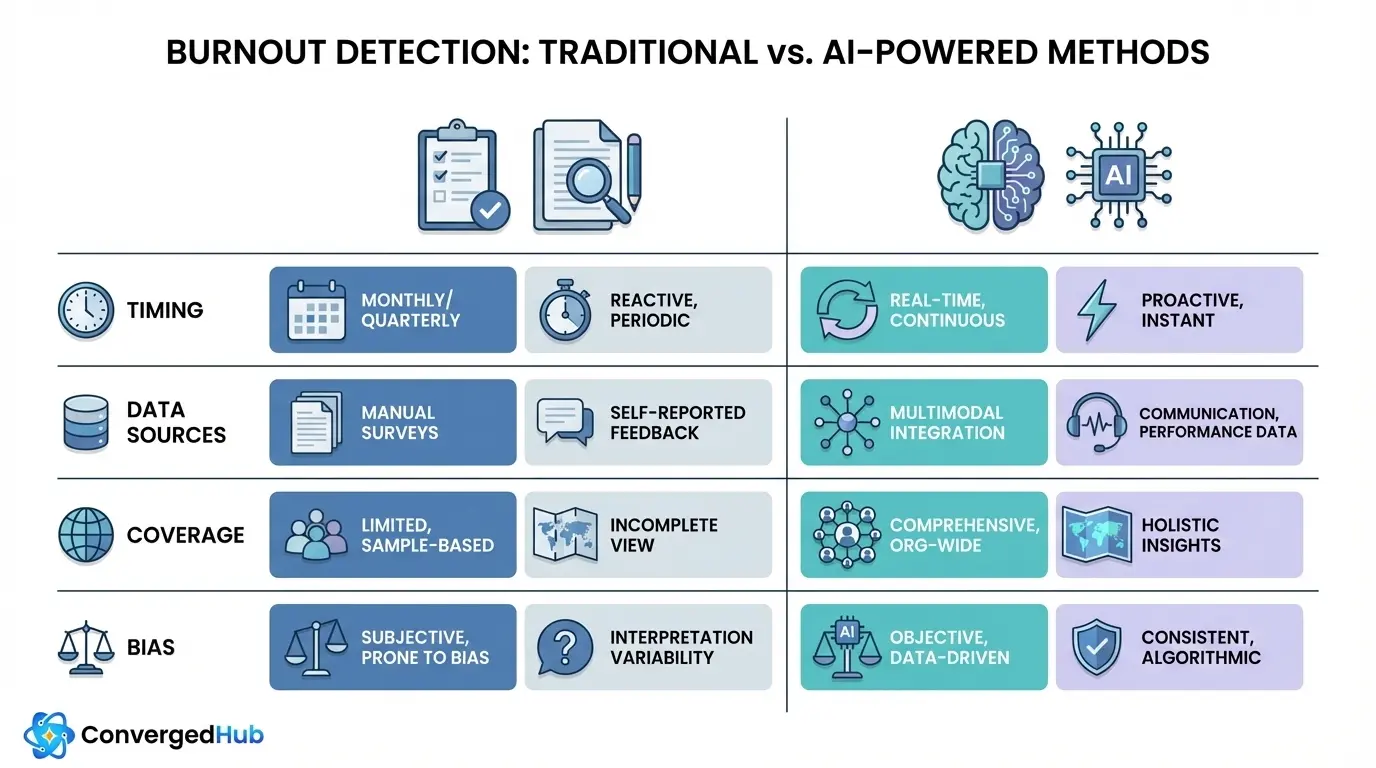
Most organizations still rely on a mix of surveys, HR reports, and supervisor intuition to manage burnout. These mechanisms are lagging, biased, and incomplete when used alone.
Engagement and pulse surveys are infrequent snapshots. Response rates are uneven across teams, self reporting is subject to fear and fatigue, and insights often arrive weeks after collection. By then, top performers may already be interviewing elsewhere.
HR metrics such as sick leave, formal complaints, or exits are even more delayed. They describe where burnout landed, not where it is building. They also rarely connect cleanly back to queue level or channel specific workload patterns.
Supervisor observation and side by side listening are valuable but extremely sample constrained. In remote and hybrid models, leaders listen to only a tiny fraction of interactions, often from agents who already seek help rather than those who stay quiet.
Even advanced call center quality assurance software tends to focus on compliance and outcome metrics. Production KPIs like AHT, CSAT, or adherence are useful, but they mask why an agent is drifting. Is it a new product, a broken workflow, or emotional exhaustion?
The result is reactive intervention. Coaching, schedule changes, or automation arrive only after performance has dropped and sentiment scores have slipped. To shift from reaction to prevention, leaders need earlier, objective indicators that live closer to the work itself: the conversations.
Signals hidden in conversations
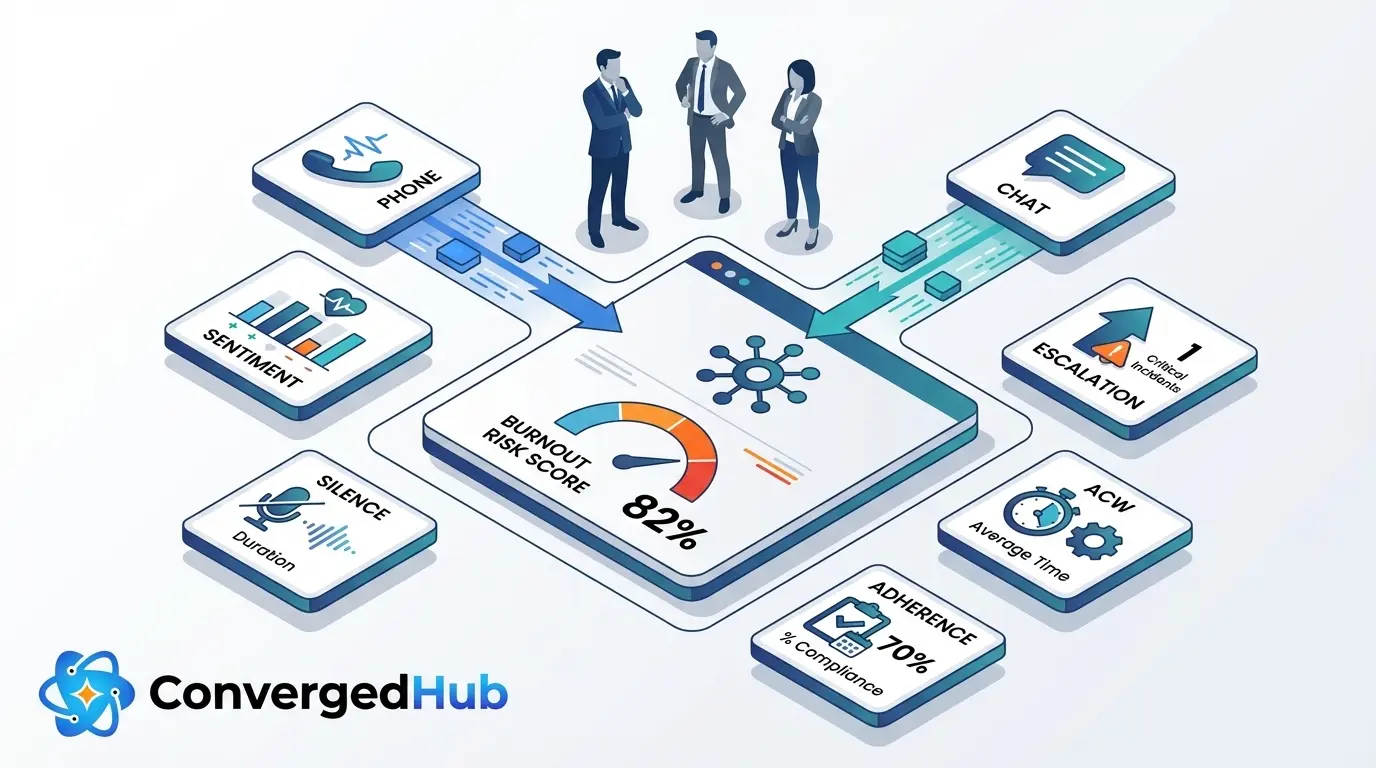
Every call and chat carries a detailed trace of agent effort, emotion, and friction. QA software burnout detection transforms these traces into quantifiable risk signals that update daily, not quarterly.
Examples of high value signals include:
- Sentiment polarity and volatility: track not just average sentiment, but swings across interactions. A rise in negative or neutral sentiment and greater volatility for a given agent compared with similar peers can indicate declining emotional capacity.
- Silence and dead air: growing spans of unproductive silence, extended holds, or awkward pauses can reflect cognitive overload, difficulty navigating systems, or emotional withdrawal.
- Talk listen ratio and interruptions: an agent who suddenly dominates the conversation, repeatedly interrupts, or conversely goes unusually quiet may be compensating for stress or disengagement.
- Escalation and transfer rates: higher than normal escalations per 100 contacts, after controlling for issue mix, are a sign that the agent is struggling to cope with complexity or conflict.
- Lexical markers of strain: repeated apologies, self criticizing language, or phrases like “I am trying my best” and “I am a bit lost” can be detected by natural language processing and flagged as potential strain.
- Greeting and closing drift: fatigue often first appears in the small rituals. Inconsistent greetings, rushed or missing closings, and script deviations carry strong signals when measured at scale.
- ACW and wrap notes: a rise in after call work time, combined with wrap notes that contain negative or frustrated language, points to growing cognitive load or emotional residue from interactions.
- Schedule adherence anomalies: when WFM data shows increased tardiness, unscheduled breaks, or shortened shifts for specific cohorts, especially alongside conversational risk markers, burnout becomes a prime hypothesis.
Individually, any of these signals may be noise. Together, over time, they provide a rich, explainable picture of agent wellbeing that pure performance dashboards cannot match.
AI risk scoring at scale
Raw signals are only useful if they can be trusted and interpreted in context. Modern qa software burnout detection uses AI to combine conversational and operational data into ensemble risk scores that are tuned to your environment.
Baselining by queue and season is essential. Sales, collections, and technical support have very different emotional profiles. AI models learn typical sentiment, silence, escalation, and AHT patterns for each queue, channel, and seasonality band. Agents are compared to their relevant peer group, not to a generic average.
Anomaly detection then differentiates short term workload spikes from sustained fatigue. For example, a week long product outage might temporarily distort silence and escalation metrics for an entire queue. Burnout detection models look for persistent deltas at the individual or cohort level that remain after the incident passes.
Cohort and individual trends are tracked with confidence intervals so that leaders can distinguish signal from statistical noise. When the system flags a risk, it can show which underlying signals contributed most, improving transparency.
Leading vendors incorporate human in the loop QA calibration. Supervisors and quality analysts review a sample of flagged interactions, confirm or reject burnout hypotheses, and add qualitative context. That feedback continuously updates model thresholds and feature weights, preventing drift and aligning the system with organizational culture.
When embedded into call center quality assurance software, these AI scores become another lens on quality, sitting alongside compliance, outcome, and experience metrics.
Operationalizing across systems
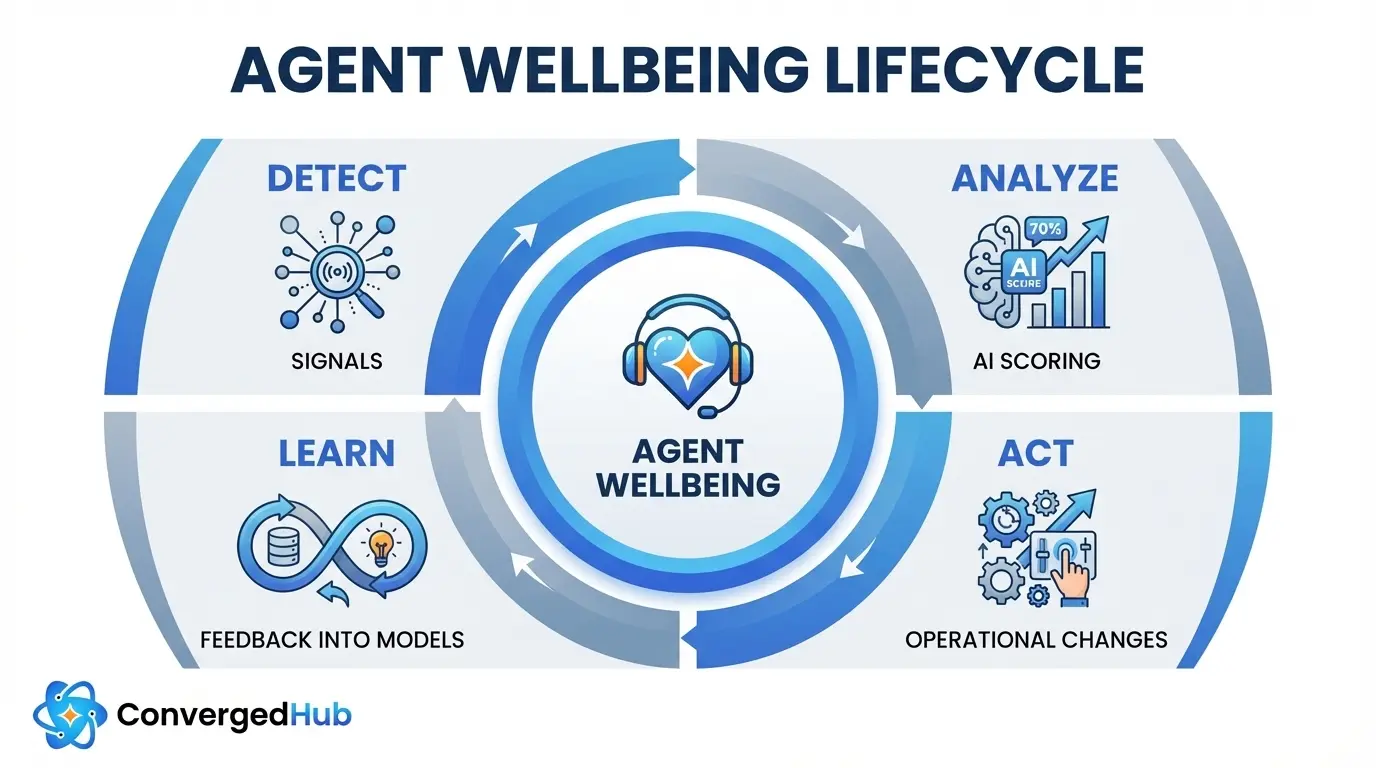
Detecting burnout risk is only half the value. The real impact comes when signals flow into day to day operations across QA, WFM, and coaching ecosystems.
Within QA workflows, risk scores can prioritize which interactions to review, so analysts spend more time on agents and queues showing early strain. Scorecards can include a burnout risk component that does not affect compensation but guides coaching focus.
In WFM systems, burnout alerts inform smarter scheduling. For example, agents with rising risk may receive fewer emotionally intensive contacts, more varied work types, or additional microbreaks without sacrificing service levels. Routing strategies can distribute complex intents more evenly instead of overloading high performers.
For coaching and learning, burnout detection can auto create tailored coaching plans and trigger microlearning modules that address specific friction points, such as new policies or tools that correlate with strain. Real time assist tools can provide extra guidance only when signals indicate rising stress during complex calls.
Automation and knowledge management teams can use aggregated burnout analytics to identify processes that consistently overload agents, then target those for self service, workflow automation, or better documentation.
At the same time, HR and people leaders can receive privacy aware, aggregated views of burnout trends by site, line of business, or tenure band, enabling proactive wellness initiatives. A clear measurement framework tracks both leading indicators (risk scores, ACW, sentiment volatility) and lagging outcomes such as attrition, AHT variance, QA compliance, CSAT, and employee NPS.
Ethics and a 90 day rollout
Because burnout analytics rely on sensitive conversational data, responsible AI principles are non negotiable. Frameworks such as the OECD AI Principles emphasize transparency, fairness, and accountability that are directly relevant to QA use cases.
Key guardrails include:
- Clear purpose and transparency: explain to agents how burnout detection works, what data is used, and what it will and will not influence. Many organizations adopt an explicit non punitive policy where risk scores feed coaching and wellness support, not disciplinary actions.
- Data minimization and pseudonymization: capture only the conversational and operational features needed, mask sensitive fields, and strictly control access paths.
- Bias testing: monitor models for systematic differences across demographics, locations, and tenure groups, and adjust features and thresholds that unintentionally amplify bias.
- Retention limits and auditability: apply clear retention windows for voice and text records linked to burnout analytics, and maintain logs of model changes and access.
A practical 90 day rollout plan might follow this arc:
- Days 1 to 30: assess data readiness, align taxonomies and outcome definitions, integrate conversation streams, and define ethical guidelines with legal and HR.
- Days 31 to 60: configure models, establish baselines and thresholds, run supervisor calibration workshops, and launch a pilot with a few queues or regions.
- Days 61 to 90: iterate based on pilot feedback, validate impact on leading indicators, finalize governance, and define criteria for broader scale out.
Resources such as Harvard Business Review’s work on burnout and McKinsey guidance on workforce fatigue can inform change management and communications as you embed burnout detection into your quality ecosystem.
As conversational AI and analytics mature, qa software burnout detection is becoming a core expectation of modern call center quality assurance software, not an experimental add on. The same tooling that understands intent, compliance, and sentiment can also protect the humans who carry your brand in every interaction.
For CX and Digital Transformation leaders, the opportunity is to treat burnout analytics as a converged capability that spans QA, WFM, coaching, and HR. Organizations that act now will not only reduce attrition and stabilize operations, they will build contact centers where agents can sustain high performance without sacrificing wellbeing.