
Press 1 for sales. Press 2 for support. Press 3 to hear these options again. For customers who live in a world of streaming, same-day delivery, and instant chat, this pattern now feels like dial-up in a 5G era.
Modern callers expect to say what they need in their own words and be understood immediately, whether they start on the phone, the web, or in a messaging app. For CX and Digital Transformation leaders, that means the IVR is no longer just a routing layer. It is a strategic, AI-powered front door to the entire customer journey.
This article is a practical blueprint to move from rigid DTMF menus to an intent-driven AI IVR that understands natural language, authenticates callers securely, orchestrates tasks across systems, and keeps context as customers shift between voice and chat. You will see how to design the architecture, de-risk security, roll out in 90 days, and prove ROI.

The CX Leader’s AI Implementation Playbook
The CX Leader’s AI Implementation Playbook is your step-by-step guide to navigating the AI revolution in customer experience. With practical frameworks, industry spotlights, and proven strategies, it gives you the roadmap to build the business case, design credible pilots, scale responsibly, and deliver measurable ROI in the next 100 days and beyond.
Why legacy IVR must go
For years, traditional IVR has been optimized around call deflection and strict process control. It did its job, but at a high cost to customer experience and brand perception.
Common failure points are now impossible to ignore:
- Cognitive overload – Long, nested menus force customers to remember options and map them to their needs, which is the opposite of how people actually think and speak.
- Brittle logic – Any change in products, policies, or org structure requires IVR reprogramming. That lag makes menus permanently out of date.
- One-channel design – Legacy IVR assumes a voice-only journey. In reality, customers bounce between web, app, chat, and phone, and expect the context to follow them.
- Hidden intent – DTMF captures the path the caller took, not the true reason they called, which limits analytics and continuous improvement.
Leaders know this is at odds with modern expectations. Research from McKinsey on AI in customer service highlights how intelligent automation can increase satisfaction while lowering cost to serve by double-digit percentages, when deployed with the customer journey at the center. You can explore their perspective on AI-enabled customer care at McKinsey.
The opportunity is clear: replace menu trees with systems that can hear ‘I need to update my billing address’ and respond with the next best action immediately, regardless of channel.
Inside an intent-driven AI IVR
An AI IVR is not just a legacy IVR with speech recognition. It is a conversational layer that sits on top of your telephony and digital channels, interpreting free-form language and orchestrating journeys across systems.
At a high level, an intent-driven AI IVR:
- Understands natural language – Using ASR (automatic speech recognition) and NLU (natural language understanding), it converts speech to text and detects intent, entities, and sentiment.
- Uses LLMs where they add value – Large Language Models help interpret messy phrasing, handle edge cases, and generate dynamic responses, while being constrained by business rules and knowledge sources.
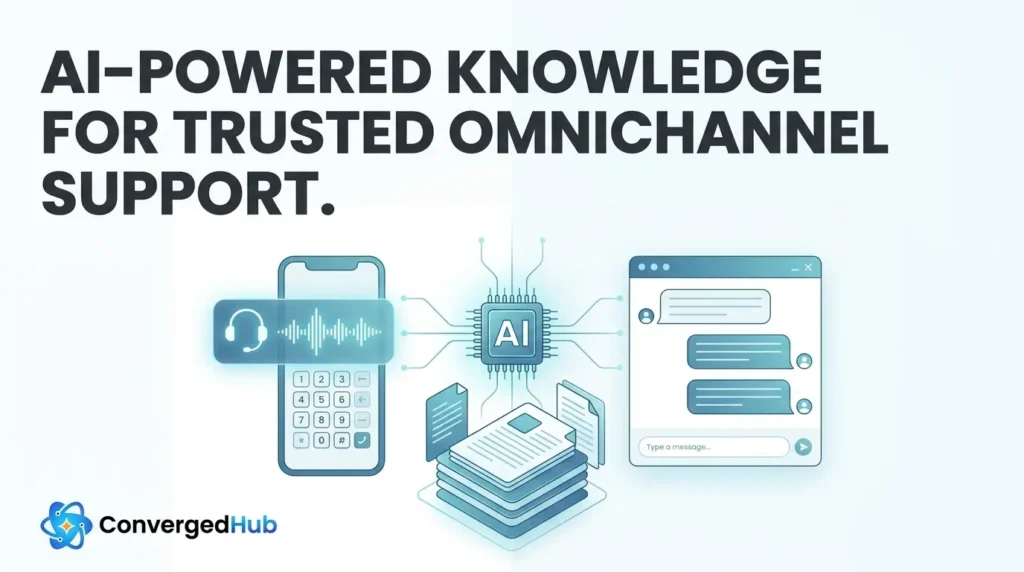
- Works across voice and chat – The same intent models and flows power phone calls, web chat, and messaging apps, so journeys feel coherent and continuous.
- Executes tasks, not just routing – It can authenticate the user, look up data in CRM, trigger RPA bots, and complete transactions end to end.
Consider two simple flows:
- Order status – Caller says, ‘Where is my last order?’ The AI IVR identifies an order-tracking intent, verifies the caller via one-time passcode or voice biometrics, pulls the latest shipment from order systems, and offers options to receive a tracking link by SMS or switch to chat for visual updates.
- Card lost or stolen – Caller says, ‘I think I lost my card.’ The system detects urgency, escalates authentication, blocks the card via an API call, and then offers self-service for replacement, with a warm transfer to an agent only if needed.
In both cases, the same logic can power chatbots on the website or app. This convergence lets you reuse investment and deliver a consistent brand voice wherever customers engage.

Architecture for converged CX
Designing an effective AI IVR is an architecture problem as much as a conversation-design problem. A reference architecture for converged voice and chat typically includes:
- Telephony and channel connectors – SIP trunks, cloud contact center platforms, or CPaaS providers route calls to the AI layer. Web chat, messaging apps, and mobile SDKs feed text into the same orchestration engine.
- Real-time speech pipeline – Low-latency ASR converts streaming audio to text. Partial results allow the system to interrupt and clarify, enabling natural barge-in instead of rigid turn-taking.
- NLU and LLM orchestration – A router decides when to use classic intent models versus LLMs. For high-volume, predictable intents (balance inquiry, appointment scheduling), deterministic NLU often wins. For long, messy utterances, an LLM can interpret context.
- Knowledge and tools layer – The AI IVR calls APIs for CRM, order management, billing, ITSM, or RPA bots, and uses retrieval-augmented generation (RAG) to ground answers in approved knowledge bases. IBM offers a good overview of RAG patterns at IBM Research.
- Policy and safety layer – Guardrails enforce which tools the AI can call, what topics it can answer, and how to mask sensitive fields.
- Analytics and monitoring – Centralized logs for transcripts, intents, drop-off points, and escalation reasons feed continuous improvement.
Latency is a make-or-break design constraint. Target sub-second response times from end of user utterance to AI reply. That usually requires:
- Edge or regional hosting for speech services
- Streaming protocols instead of request-response
- Caching of prompts, policies, and common responses
- Right-sizing models to match use cases, not defaulting to the largest possible LLM
When evaluating vendors, focus on their ability to orchestrate multiple models, connect to your existing telephony stack, and expose fine-grained controls rather than a single black box.
Security, risk, and compliance
As AI IVR moves from experiments to production, security and trust become non-negotiable. You are not only automating calls; you are handling authentication, payment details, and sensitive account information.
Key design principles include:
- Data minimization and PII redaction – Transcripts and logs should automatically mask names, card numbers, social security numbers, and other identifiers. Use field-level encryption at rest and in transit, and restrict who can access raw data.
- Consent management – At call start, clearly explain recording, AI assistance, and any use of biometrics. Capture consent (or route to human-only paths) and store that decision with the interaction record for audit.
- Secure authentication – Combine knowledge-based questions, one-time passcodes, device signals, and optional voice biometrics to reach the right level of assurance by use case. Voice prints must be encrypted, revocable, and subject to strict retention rules.
- Model governance – Maintain a registry of models in use, their training data sources, and their allowed tasks. Align this with emerging frameworks like the NIST AI Risk Management Framework.
- Regulatory alignment – Ensure that your AI IVR respects sector-specific rules (for example, HIPAA, PCI DSS, or financial conduct regulations) and data protection regimes like GDPR, outlined at GDPR.eu.
From an operational standpoint, treat AI IVR as part of your critical infrastructure. That means role-based access control, change management processes, disaster recovery plans, and regular red-team exercises to test for prompt injection, impersonation, or data leakage risks.

90-day rollout playbook
A full AI IVR transformation does not have to be a multi-year epic. With a focused scope, you can launch a high-impact pilot in roughly 90 days.
Days 1 to 30: Discover and design
- Audit top intents – Analyze call recordings, IVR paths, and digital chat logs to identify the 20 to 30 intents that drive most volume and handle time.
- Define success metrics – Agree on target containment rate, AHT reduction, CSAT lift, and acceptable abandonment thresholds for the pilot.
- Design conversational flows – For each priority intent, sketch happy paths, failure paths, and escalation triggers. Incorporate verification steps and cross-channel options (for example, offer to send a payment link via SMS or continue in web chat).
- Choose pilot entry points – Start with a dedicated phone number or a specific IVR branch to limit blast radius while still capturing value.
Days 31 to 60: Build and integrate
- Configure NLU and policies – Train or tune intent models using historical utterances. Define what the AI can and cannot do for each intent.
- Integrate systems – Connect to CRM, order management, billing, ITSM, and RPA platforms so the AI IVR can perform real work, not just answer FAQs.
- Implement security controls – Turn on PII redaction, role-based access, logging, and monitoring. Test authentication flows end to end.
- Test sample journeys – Run scripted and unscripted tests with internal users across both voice and chat, focusing on edge cases and escalation quality.
Days 61 to 90: Pilot and iterate
- Launch to a limited audience – Gradually ramp traffic, starting with lower-risk intents and off-peak hours.
- Monitor KPIs daily – Track containment, AHT, CSAT, abandonment, and transfer reasons. Listen to transcripts where the AI struggled.
- Iterate flows and prompts – Adjust prompts, add clarifying questions, refine disambiguation logic, and re-balance when to use LLMs versus deterministic flows.
- Prepare agents – Train agents to handle AI-assisted transfers with full context and to tag misrouted calls, which feeds back into model improvements.
By the end of 90 days, you should have a live reference implementation, hard data on performance, and a backlog of enhancements to guide broader rollout.
KPIs, guardrails, and ROI
To move beyond hype, AI IVR needs a clear performance framework and a sober view of value creation.
Core KPIs include:
- Containment rate – Percentage of interactions fully handled by AI (across voice and chat) without agent involvement, adjusted for customer satisfaction.
- Average handle time (AHT) – For calls that still reach agents, AHT should drop due to better intent capture and pre-work by the AI.
- Customer satisfaction – Use post-call surveys and digital feedback to measure CSAT or NPS specifically for AI-handled interactions.
- Abandonment and transfer rates – High abandon or transfer indicates misalignment between intents, flows, and customer expectations.
- Resolution quality – Audit a sample of AI resolutions for accuracy, policy adherence, and tone.
Guardrails against hallucinations and errors are essential:
- Use RAG to ground responses in approved knowledge, not general web data.
- Limit LLM use for regulated transactions; rely on deterministic APIs for balances, payments, and order changes.
- Enforce allowlists of tools and topics, with fallbacks like ‘I am not able to do that, let me connect you to a specialist’ when outside the safe envelope.
- Implement human-in-the-loop review for new or complex intents before allowing full automation.
For ROI, build a simple model:
- Annual call volume in scope multiplied by portion automated by AI IVR, multiplied by current cost per agent-handled call (including overhead) equals gross savings.
- Factor in incremental revenue from better upsell or reduced churn, plus quality savings from fewer errors.
- Subtract AI IVR platform, integration, and run costs to get net benefit.
McKinsey’s work on the future of customer care shows that organizations combining intelligent automation with smart routing can reduce contact center costs by 20 to 40 percent while improving experience. You can read more at McKinsey.
When evaluating vendors, use a checklist that covers telephony compatibility, intent and LLM orchestration, security certifications, analytics depth, support for converged voice and chat, and the flexibility to bring your own models as needs evolve.
The era of ‘press 1 for sales’ is ending. Customers are telling you exactly what they want in their own words across every channel. An intent-driven AI IVR lets you finally listen at scale, respond intelligently, and resolve tasks without friction.
For CX and Digital Transformation leaders, the path forward is not a rip-and-replace gamble. It is a focused, 90-day journey to modernize high-impact journeys, prove value, and then scale. By combining a solid architecture, rigorous security, clear KPIs, and a converged view of voice and chat, you can deliver the kind of effortless experience customers already assume you have.
Now is the moment to retire the phone tree and open the front door to a truly conversational enterprise.