
Phone menus were designed for a world where customers had time and patience. That world has vanished. Your customers pause a streaming show on one device, resume on another, and expect the same continuity when they reach your contact center. Instead, they repeat account numbers, re explain problems, and bounce between channels that do not share context.
For CX and digital transformation leaders, that disconnect has become unsustainable. Voice remains the most emotionally charged and high value channel, yet traditional IVR and first generation bots are static, transactional, and blind to data that lives in CRM, CDP, and web or app journeys.
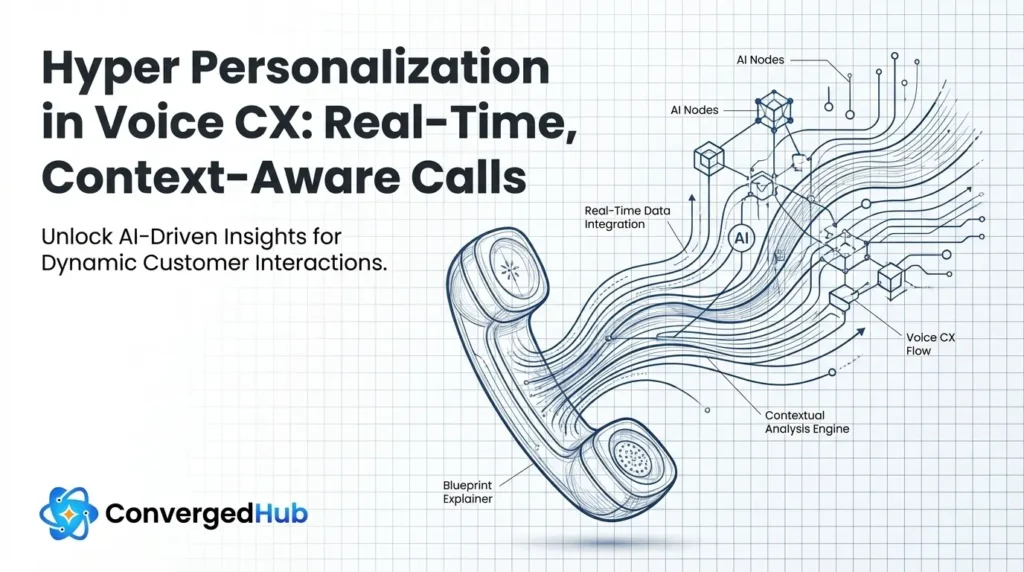
Personalized Voice AI promises a different model. It fuses customer data, interaction history, and real time signals into an automated experience that feels natural, remembers, and adapts. The voice channel stops acting like a call tree and starts behaving like a trusted, always on representative that knows who is calling, why they are likely calling, and what should happen next.
This guide takes a vendor neutral look at how to design, build, and scale Personalized Voice AI that is context aware and human like across channels. We will unpack the core stack, real time personalization flows, types of personalization that matter, high impact use cases, integration patterns, guardrails, and a practical roadmap from pilot to scaled transformation.

Conversational Voice AI – Value Estimator
Quantify the business impact of Conversational Voice AI in minutes.
Use this estimator to:
- Build a data-backed ROI narrative to support executive and board-level decision-making
- Model potential cost savings driven by Voice AI–led call automation and containment
- Quantify productivity gains from reduced agent workload and lower average handle time
- Assess operational efficiency improvements across high-volume voice interactions
Why Legacy Voice Falls Short
Despite investments in IVR and basic voice bots, many contact centers still feel like walled gardens that ignore the rest of the digital experience. Customers move from app to web to voice, but the system treats every call as a blank slate.
Three structural problems drive this frustration:
- No memory. The IVR does not reliably know who the caller is, what just happened in other channels, or which promises the brand made in the past. Customers re authenticate and repeat details that already exist in CRM or billing systems.
- No empathy. Scripts are rigid, tone is robotic, and flows do not adapt to urgency, frustration, or vulnerability. The system cannot slow down for an older caller, speed up for a power user, or show care after a service outage.
- No continuity. Web, app, and agent channels rarely share a single view of the journey. Research from Gartner on customer experience expectations shows that customers increasingly judge brands on seamlessness across channels, not on isolated touchpoints.
The result is high effort experiences, avoidable transfers, and agent time spent re gathering information rather than resolving issues. Personalized Voice AI aims to reverse this dynamic by treating every interaction as part of a connected story, not an isolated phone call.
Core Stack of Personalized Voice AI
Personalized Voice AI is not just a better IVR script. It is a stack of capabilities that work together to understand, remember, and act. At a high level, the stack looks like this:
- Data integration layer. Connects to CRM, CDP, billing, order management, ticketing, and marketing systems to assemble a secure, unified customer profile and recent activity timeline.
- Context management. Maintains session state across channels and time: who the customer is, what they are trying to do, what was already said, and which policies apply. This is the brain that prevents repetition and allows the system to pick up where the customer left off.
- Automatic speech recognition. Transforms raw audio into text while handling accents, noise, and domain specific vocabulary. High quality ASR is essential for accurate intent detection and low handle time.
- Natural language understanding and generation. Interprets intent, entities, sentiment, and nuance in the customers words, then crafts responses that are clear, concise, and aligned with brand tone.
- Decisioning and policy engine. Evaluates eligibility, business rules, pricing logic, and risk thresholds to determine the next best action for this specific customer in this specific moment.
- Voice synthesis layer. Converts responses to speech with a controllable voice that can vary speed, emphasis, and energy. This is where human like qualities such as warmth and confidence are expressed.
When these components are orchestrated correctly, the voice experience stops being menu driven and becomes goal driven, continuously shaped by context and data.

Inside Real Time Personalization
To design effective Personalized Voice AI, it helps to visualize what happens in the first few hundred milliseconds after a customer says hello. A modern system runs a coordinated sequence:
1. Identify caller and retrieve history. Using phone number, authentication methods, and device or account identifiers, the platform locates the customer profile and recent interactions across channels.
2. Detect intent and sentiment. ASR and NLU parse the first utterance to detect why the customer is calling, key entities such as products or locations, and emotional tone such as frustration or urgency.
3. Enrich with behavioral and journey signals. The system checks digital breadcrumbs: abandoned carts, failed logins, recent email clicks, app crashes, or open tickets. This context narrows likely needs before the conversation even begins.
4. Run policy and eligibility checks. Business rules determine what the AI is allowed to do: waive a fee, adjust an order, change a plan, or schedule a technician. Risk, compliance, and loyalty status all influence these boundaries.
5. Select and personalize the response. The decision engine chooses the best next action and tailors the message: what to say, what not to say, and how to say it, including tone and level of detail.
6. Coordinate with agents when needed. If handoff is required, the system passes full context, transcripts, and recommended actions to the agent desktop so that customers do not need to start over.
Done well, this pipeline makes automation feel almost telepathic. Customers experience less effort not because the menu is shorter, but because the system already understands most of the story when the call connects.
Personalization Types That Win
Personalized Voice AI is not a single monolithic capability. It combines multiple styles of personalization that work together.
Contextual personalization. Adapts to real time context such as time of day, region, device, current location in the app, or a recent outage. For example, a customer calling during an outage hears proactive reassurance and tailored status updates rather than generic menus.
Behavioral personalization. Uses past behavior to adjust style and flow. A frequent flyer who always uses self service can be offered faster, more advanced options, while a new customer is guided with more explanation and confirmation steps. Speaking pace and word choice can adjust based on how the customer responds.
Predictive personalization. Machine learning models estimate likelihood of churn, upgrade, or non payment, then steer the conversation toward the most valuable and considerate outcome. For background on these techniques, resources such as IBM on predictive analytics are helpful starting points.
Journey based personalization. Aligns the voice experience with where the customer is in the lifecycle and in the current journey. Onboarding, billing issues, renewals, and win back scenarios each warrant distinct tones, flows, and success metrics. The AI uses journey stage as a lens for every decision it makes.
When these layers align, customers experience the brand as perceptive and consistent, not intrusive. The goal is to feel thoughtfully anticipated, never watched.

Enterprise Use Cases and Benefits
With the right foundations, Personalized Voice AI unlocks powerful enterprise use cases that go far beyond basic containment.
- Tailored support at scale. The system recognizes the customer, confirms identity with minimal friction, and jumps directly into likely resolutions based on recent activity. For example, if a shipment is delayed, the AI offers an update and options before the customer asks.
- Proactive recommendations and offers. For a subscriber who frequently exceeds data limits, the AI can recommend a better plan, explain tradeoffs, and apply changes in one seamless conversation. Research from McKinsey on personalization and growth highlights how such relevance drives both revenue and loyalty.
- Intelligent routing and authentication. Voice biometrics, risk scoring, and recent activity reduce friction while keeping fraud in check. When escalation is needed, the AI chooses the best skill group and passes full context so the agent can focus on resolution, not discovery.
- Retention and recovery. Predictive signals surface customers at risk of churn or dissatisfaction. The AI can trigger save offers, survey follow ups, or callbacks that feel timely and relevant rather than random.
Measured impact typically appears across key CX and efficiency metrics. Brands see higher CSAT, improved Net Promoter Score, and lower customer effort. At the same time, they reduce average handle time and increase first contact resolution, while lifting conversion on targeted offers. For a deeper look at NPS methodology, Harvard Business Review provides a useful overview in The One Number You Need to Grow.The most successful programs treat these use cases as a portfolio, starting with a focused journey and expanding as data, trust, and organizational confidence grow.
Integrations, Risks and Scale Roadmap
Personalized Voice AI must live inside the broader CX ecosystem, not beside it. That means robust integrations and thoughtful governance.
Key integration domains include:
- CRM and CDP. Provide the source of truth for identity, preferences, and lifecycle stage.
- Ticketing, WFM, and QA. Align automated and agent assisted workflows, balance staffing, and feed QA teams with transcripts, sentiment, and outcome data.
- Knowledge bases and content hubs. Supply trusted answers and procedures so the AI can reason over accurate, current information.
- Analytics and data warehouse. Capture interaction level data for experimentation, attribution, and model improvement.
- Omnichannel platforms. Ensure that context flows between voice, chat, messaging, and email so customers can channel hop without losing their place.
Guardrails and responsible design are equally important:
- Privacy and consent. Governance must align with regulations such as the European Union General Data Protection Regulation, explained at gdpr.eu. Customers should understand what data powers personalization and have easy ways to opt out.
- Data minimization. Collect and retain only what is necessary for defined outcomes. Sensitive attributes require extra care and clear justification.
- Bias and fairness. Regularly test models for disparate impact across demographic groups and provide override mechanisms when automated decisions conflict with policy or ethics.
- Over personalization. Avoid experiences that feel invasive. Use personalization to reduce effort and improve clarity, not to surprise customers with how much you know about them.
- Explainability and auditability. Maintain logs that show why decisions were made, which policies applied, and which data sources were used.
A practical roadmap for CX and digital leaders typically follows five steps:
- Data readiness and governance. Inventory data sources, define access controls, and set clear rules for using data in personalization.
- Experience design. Map target journeys, define success metrics, script desired tones, and specify escalation paths to agents.
- Pilot and experimentation. Start with one or two journeys, measure baseline CSAT, NPS, AHT, and FCR, then iterate through A B tests.
- Change management for agents. Involve frontline teams early, position Voice AI as a copilot that removes repetitive work, and integrate insights into coaching and quality programs.
- Scale and continuous optimization. Gradually expand to more journeys and segments, while monitoring through dashboards and cross functional governance. External resources such as Gartners customer experience insights can help benchmark maturity and prioritize next moves.
Handled this way, Personalized Voice AI becomes a durable capability in the CX operating model, not just another project.
Personalized Voice AI is ultimately about respect for customers time, history, and intent. When your voice channel understands context, remembers past interactions, and chooses the best next step in real time, automation no longer feels like a barrier. It becomes a trusted first line of service.
For CX and digital transformation leaders, the opportunity is clear. The same intelligence that powers leading digital experiences can now live in your contact center, across voice and chat, without sacrificing control or customer trust. The organizations that act now will set the new standard for human like, context aware CX at scale.