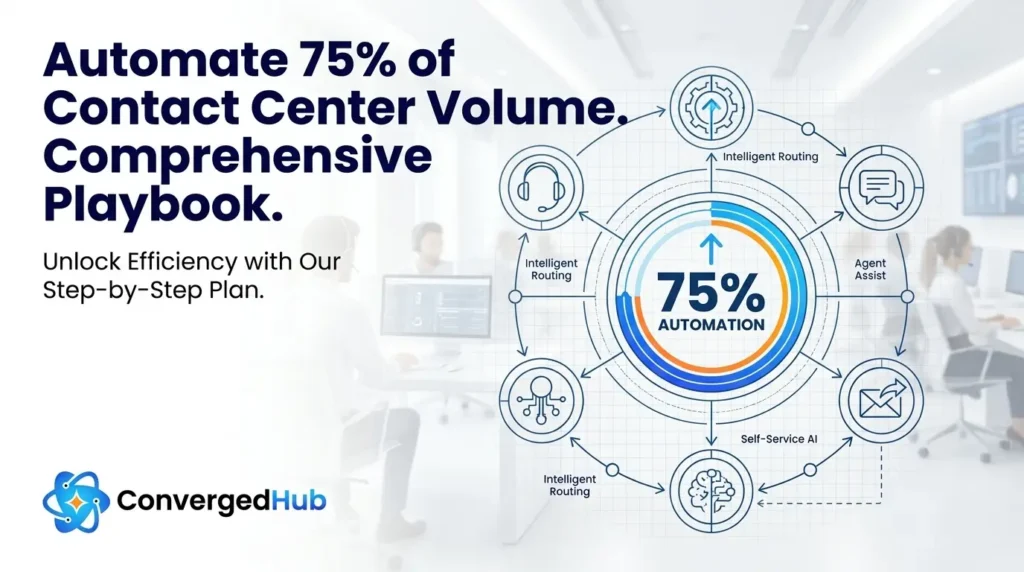
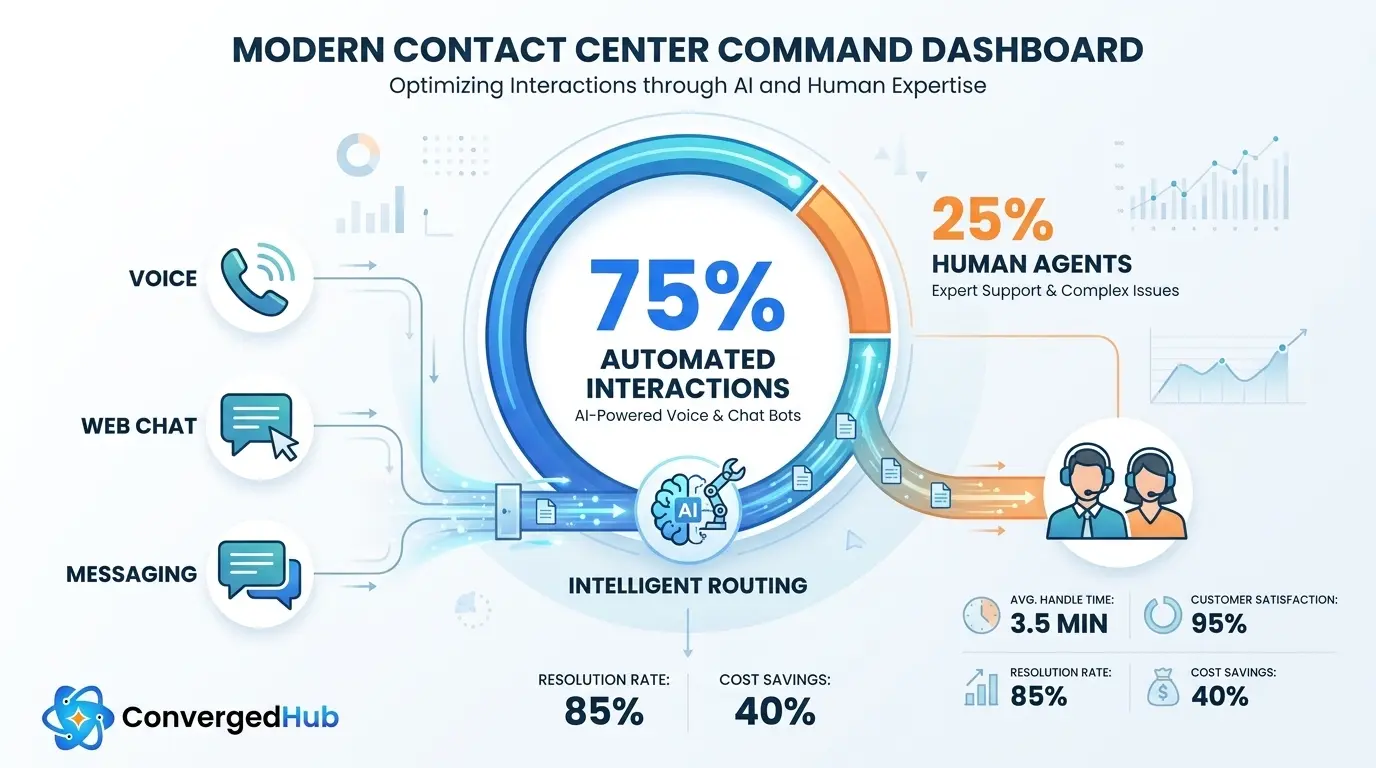
Support leaders are no longer asking whether to automate their contact center. The question is how far, how fast, and without breaking the customer experience. For many enterprises, the practical ceiling is higher than expected: with the right strategy, it is realistic to automate as much as 75% of contact volume across voice and chat while making the remaining 25% more human, not less.
This playbook is written for CX, Digital, and Operations leaders who are under pressure to improve NPS and CSAT, tame costs, and create resilient service models. It lays out a concrete path: start with demand intelligence, focus on the right use cases, design converged voice and chat journeys, pair automation with intelligent human handoff, and govern with data. It is vendor neutral and immediately usable, whether you are modernizing an existing IVR or deploying a new conversational AI platform.
Think of this as the operating manual for scaled contact center automation: practical enough for operations teams, strategic enough for C-level stakeholders, and grounded in what leading organizations are already doing, as described by firms such as Gartner and McKinsey.

Conversational Voice AI – Value Estimator
Quantify the business impact of Conversational Voice AI in minutes.
Use this estimator to:
- Build a data-backed ROI narrative to support executive and board-level decision-making
- Model potential cost savings driven by Voice AI–led call automation and containment
- Quantify productivity gains from reduced agent workload and lower average handle time
- Assess operational efficiency improvements across high-volume voice interactions
Why automation is urgent
Customer behavior has shifted permanently. Customers expect real-time answers on the channel that suits them in the moment: voice while driving, web chat during a meeting, asynchronous messaging on mobile. At the same time, labor markets are tight, support complexity is rising, and leadership is tasked with improving experience while also reducing cost-to-serve.
From side project to operating system
Contact center automation used to mean adding an IVR menu or a basic FAQ chatbot. Today, leading organizations treat automation as a core capability that touches routing, self-service, assisted service, quality, and analytics. According to Harvard Business Review, companies that successfully operationalize AI do not treat it as a one-off project but as an organizational transformation.
In a typical enterprise, a minority of interactions are complex, emotionally charged, and require senior agents. The majority are repetitive, policy-driven, and structurally similar across customers. These are ideal candidates for conversational AI and workflow automation. When automated well, they free agents to focus on high-value work and give customers faster resolution.
The real north star: right first resolution
The goal is not bots everywhere. The north star is right resolution on the first attempt: automated when possible, assisted when valuable, escalated when necessary. In practice, that means designing journeys where self-service, proactive outreach, and human support work together, not in competition. Automation absorbs predictable demand and prepares context; agents handle nuance, empathy, and exception handling. Get this balance right and 75% automation becomes a byproduct of good design rather than a forced target.
Map and segment demand
The ceiling on contact center automation is determined less by technology and more by how well you understand demand. Before building any flows, invest in a robust 90-day analysis of why customers contact you, through which channels, and how those issues are currently resolved.
Build a single view of contact reasons
Pull data from telephony, chat, email, messaging, CRM, and knowledge systems into a unified taxonomy. This often means rationalizing hundreds of inconsistent reason codes into a clear list of customer jobs to be done: order status, password reset, billing inquiry, claim update, appointment scheduling, and so on. Include:
- Call and chat transcripts, IVR paths, and messaging logs
- Disposition and CRM reason codes
- Self-service logs and on-site search queries
- Agent notes and quality monitoring outcomes
- Voice-of-customer surveys and complaints
Ensure that personally identifiable information is masked and that transcripts carry accurate timestamps and anonymized agent identifiers. Build a repeatable monthly pipeline so this analysis is not a one-time event but an ongoing insight engine.
Tag complexity and automatable potential
Next, cluster interactions into intents and tag each across dimensions that affect automability:
- Complexity: single-step informational vs multi-step problem solving
- Authentication: none, lightweight, or high-assurance
- System actions: read-only lookup vs write-back to core systems
- Risk: regulatory, financial, or brand risk if something goes wrong
- Preferred channel: where customers start and where they prefer to finish
Run a deflection analysis to see which interactions could be resolved earlier via proactive messages, status pages, or in-product notifications. The output of this phase is a ranked map of high-volume, low-to-medium complexity intents that are strong candidates for automation in both voice and chat.
Prioritize high-ROI use cases
Once you understand your demand, translate it into a pragmatic automation backlog. Not every intent is worth automating, especially at the start. Focus on the intersection of customer value, business impact, and implementation feasibility.
Score by impact, effort, and risk
For each candidate intent, create a simple scoring model:
- Impact: volume, current handle time, cost-to-serve, and CX pain indicators such as recontact rate or low CSAT
- Effort: availability of APIs, authentication requirements, policy complexity, and the number of systems to orchestrate
- Strategic value: potential to differentiate experience, influence retention, or reduce regulatory exposure
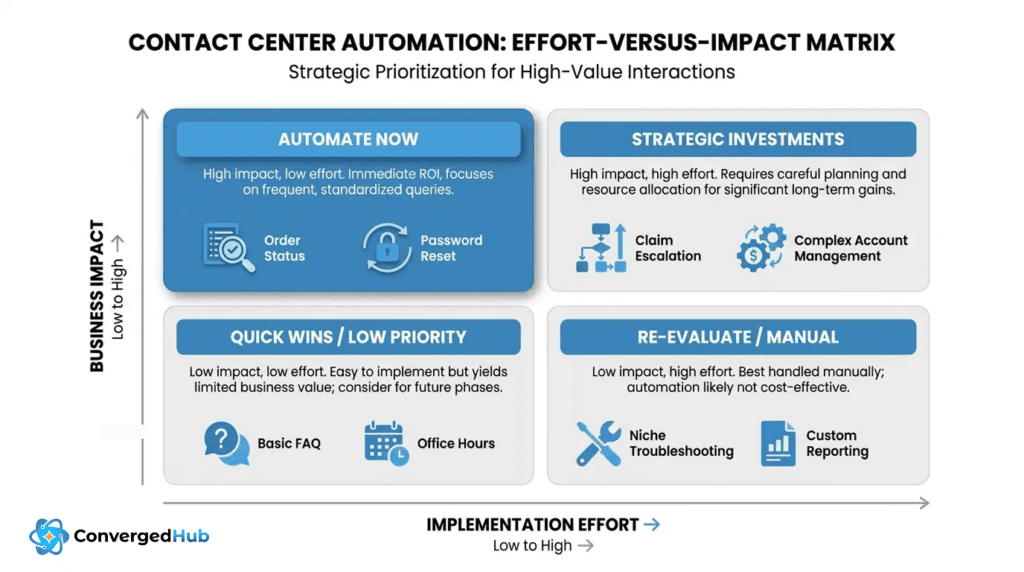
Visualize this as an effort versus impact matrix. Intents that are high impact and low to medium effort form your initial wave. Low-impact, high-effort intents move to the bottom of the roadmap, regardless of how interesting they may seem.
Create a 90-day automation backlog
For the first 90 days, pick 6 to 10 well-defined use cases across your top channels. Common quick wins include:
- Account status and order tracking
- Password reset and access recovery
- Simple billing questions and usage summaries
- Appointment booking and rescheduling
- Address or contact detail updates
- Knowledge lookups for policy and FAQ content
For each, define precise entry conditions, success criteria, and fallback rules. Assign an owner, identify required integrations, and document content gaps. This backlog becomes the backbone of your first release plan and a tangible artifact you can share with stakeholders across CX, IT, and compliance.
Design converged journeys
Customers experience your brand, not your org chart. They do not care whether a capability sits in IVR, chat, or a mobile app; they care whether they can resolve their issue quickly with minimal effort. That makes converged journey design a critical step.
Unify logic across voice and chat
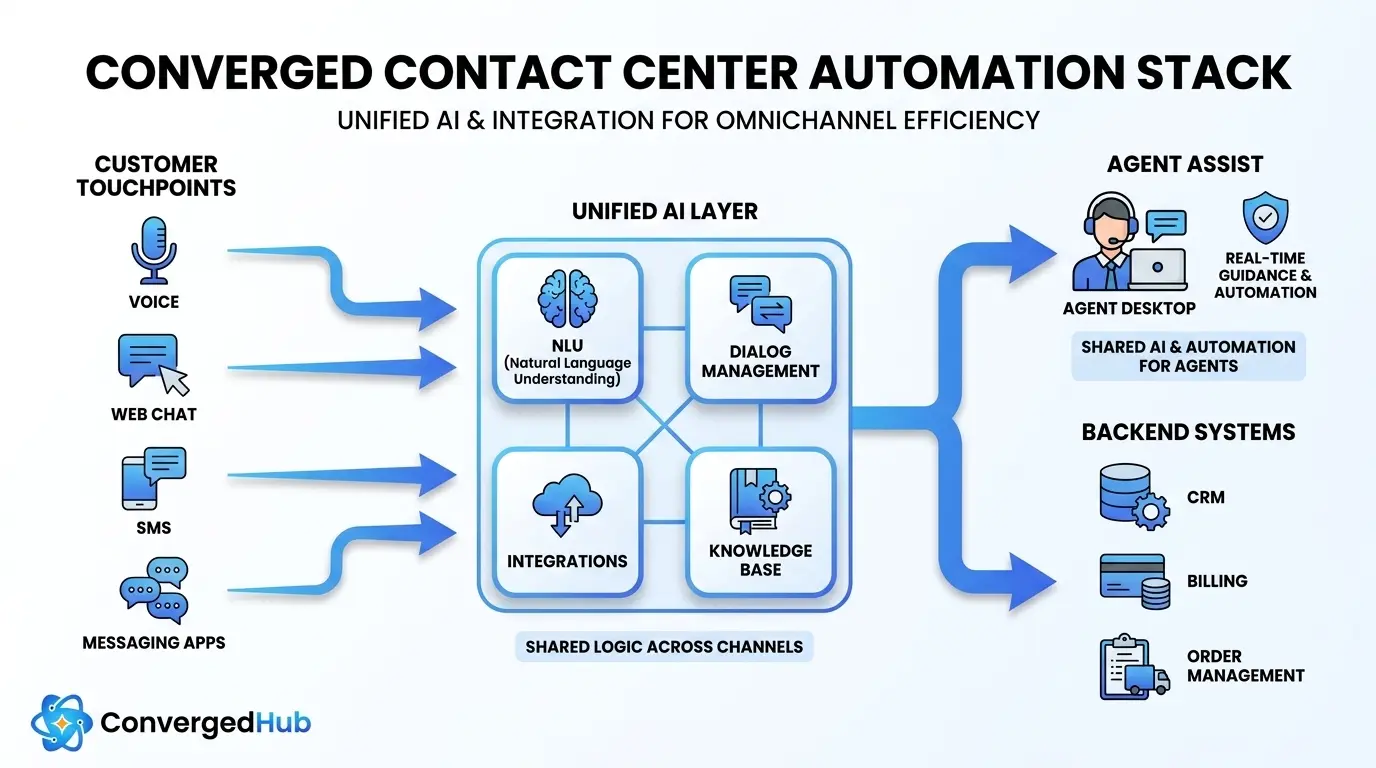
The same intent should behave consistently regardless of channel. Instead of separate flows for IVR and chatbot, build shared intent models and business logic, then expose them through different modalities. For example, an order status intent should pull from the same backend service whether the customer calls, uses web chat, or interacts via WhatsApp.
For complex tasks, consider voice-to-visual handoffs: start in voice, then send a secure SMS or in-app link to complete steps that are easier with a screen, such as form fills, document uploads, or rich confirmations. This converged voice plus visual approach lowers friction without forcing channel switching midstream.
Design conversations, not menus
Effective contact center automation feels like a helpful conversation, not a decision tree. Core design principles include:
- Lead with open prompts such as “How can I help today?” rather than rigid menus
- Confirm understanding briefly and offer the top two to three interpretations if confidence is low
- Keep turns short, clarify progressively, and summarize outcomes
- Provide clear explanations for any authentication or data request
Plan for smart escalation from the outset. Define thresholds for low model confidence, extended duration, or negative sentiment that should trigger handoff to a human. When escalation happens, pass the full transcript, customer profile, and attempted actions into the agent desktop so customers are not asked to repeat themselves.
Organizations that excel here treat conversation design as a distinct discipline, much like UX design, with its own standards, checklists, and testing routines.
Build the automation stack
With demand mapped and journeys designed, you can define the technology and operating model needed to support scaled contact center automation. The emphasis should be on interoperability and control rather than on any single tool.
Core platform capabilities
Your stack typically needs to cover:
- NLU and dialog management that support multi-turn, context-aware conversations
- Knowledge retrieval using search or retrieval-augmented generation from curated, up-to-date content sources
- Integration to CRM, billing, order management, ticketing, and authentication systems
- Connectors into telephony or CCaaS platforms, web chat, SMS, and messaging apps
Modern platforms such as ConvergedHub.AI are designed to orchestrate these layers so that voice and chat automation share intelligence, content, and analytics.
Guardrails, content, and assisted service
Robust governance is what turns a promising pilot into a sustainable operating model. Focus on:
- Security and privacy: PII redaction, secure tokens, and auditable logs
- Grounded generation: responses constrained to approved data sources to avoid hallucinations
- Content operations: clear ownership, publishing workflows, and review cycles for knowledge articles and policies
Equally important is investing in assisted service capabilities. Contact center copilot tools can surface next-best actions, auto-generate summaries, and prepopulate after-call work, reducing handle time and improving consistency. Forrester highlights in its customer service research that combining self-service with strong agent assistance yields better outcomes than focusing on either in isolation.
By designing automation and human assistance together, you avoid a fragmented experience where bots handle some tasks while agents are left blind to what happened previously.
Launch, govern, and scale
Automation performance is not determined at go-live; it is shaped over weeks and months of iteration. Treat launch as the beginning of a continuous improvement loop rather than the end of a project. This mindset is what allows organizations to move from 10% automation to 50% and beyond.
Start small, measure deeply
Begin with three to five intents in a single channel, including a mix of informational and transactional flows. Instrument each journey with metrics that matter:
- Automated resolution and containment rate per intent
- Transfer, abandonment, and recontact rates
- Average handle time impact on assisted contacts when automation is in front of or alongside agents
- Customer effort scores and post-interaction CSAT
- Accuracy and safety review of a sample of transcripts
Review low-confidence turns, dead ends, and common free-text phrases weekly. Add missing utterances, refine prompts, and patch content gaps. Small, frequent adjustments compound into substantial gains in containment and satisfaction.
Establish governance and a scale roadmap
Create a regular operating rhythm: a weekly standup for intent owners, operations, and compliance to review performance and a monthly forum to reprioritize the backlog. As the foundation stabilizes, expand:
- Roll out automation to a second channel, typically moving from chat to voice or vice versa
- Add higher-value transactional intents with stronger authentication and deeper integrations
- Introduce proactive outreach that prevents avoidable contacts, such as status notifications or renewal reminders
- Layer in personalization based on customer history and preferences, within privacy constraints
Combined, these steps can realistically push many organizations toward automating a majority of repetitive contacts, sometimes approaching 75% of overall volume, while human agents focus on complex, high-empathy interactions that build loyalty.
Automating up to 75% of contact center volume is not about chasing a vanity metric or replacing people with bots. It is about building a disciplined, insight-driven system where automation and human expertise reinforce each other. You begin by understanding demand, targeting the right use cases, and designing converged voice and chat journeys that customers actually want to use.
From there, the work is continuous: expand automation across channels, strengthen integrations, keep content fresh, and refine conversations based on real interactions. Leaders who embrace this approach turn contact center automation from a risky experiment into a durable advantage that improves CX, stabilizes costs, and makes work more meaningful for agents.
The next step is straightforward: launch your 90-day demand analysis, choose three to five starter intents, and define how you will measure success. With a structured playbook and the right partners, your organization can move from scattered pilots to a scalable automation strategy that withstands the next wave of customer and business change.