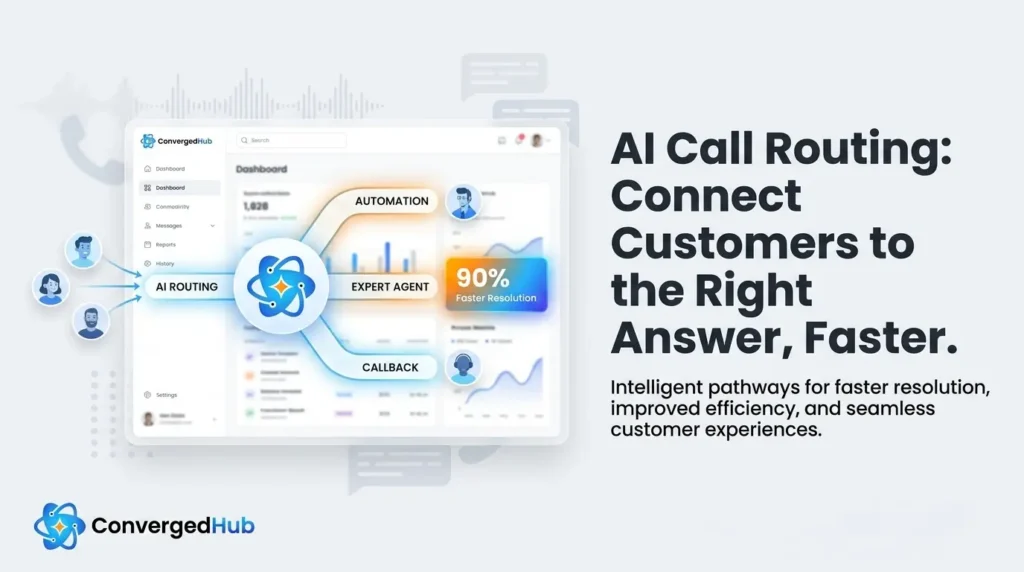
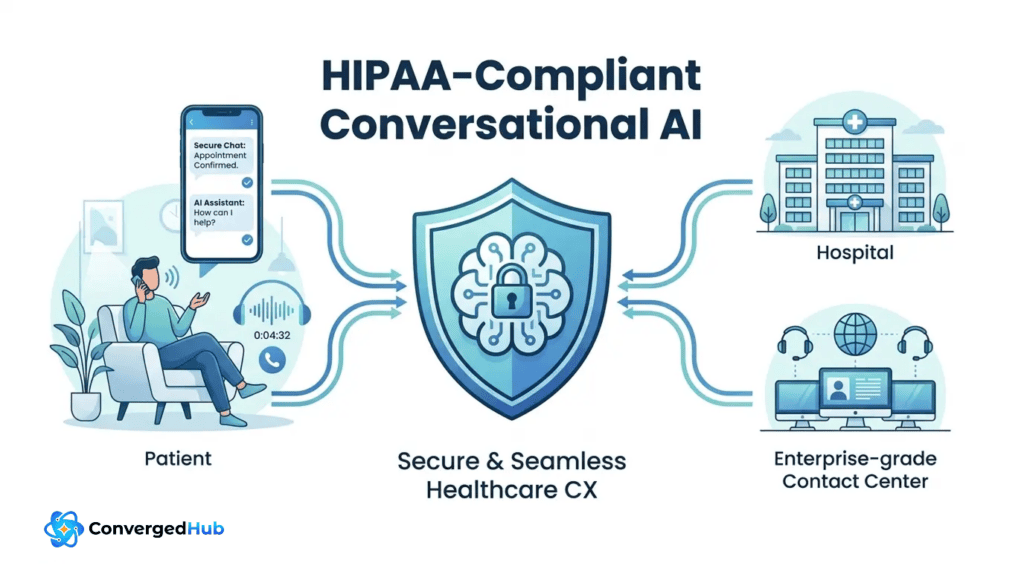
At 7 p.m., a mother calls about her child’s fever. At 11 p.m., a post-op patient taps out a worried text about new pain. Your contact center has a choice: force them to wait for a human, or let HIPAA compliant conversational AI respond instantly without compromising privacy.
For healthcare CX and digital transformation leaders, this is no longer a theoretical trade-off. Done well, HIPAA compliant conversational AI becomes a quiet engine of confidence: patients share what is needed, get help faster, and feel safe doing it. Done poorly, it becomes yet another privacy risk and brand liability.
This article goes beyond generic ‘secure chatbot’ talk. It explores how HIPAA compliant conversational AI can upgrade healthcare CX across voice and chat, how to architect it for protection of PHI end-to-end, which use cases to launch first, and how to evaluate vendors so you do not discover compliance gaps after go-live.

AI Readiness Maturity Scorecard
Use this scorecard to:
- Assess your organization’s current readiness across strategy, data, technology, people, and governance
- Identify capability gaps that could limit the success of AI and automation initiatives
- Evaluate alignment between business objectives, operating models, and AI adoption plans
- Benchmark maturity across key dimensions required for scalable AI transformation
- Prioritize investments needed to move from experimentation to enterprise-wide AI impact
- Build a clear, actionable roadmap for advancing AI readiness with measurable milestones
What HIPAA AI Really Is
In healthcare, ‘secure chatbot’ is not enough. HIPAA compliant conversational AI is a specialized assistant for voice and chat that can understand natural language, complete tasks, and safely handle protected health information (PHI) under the HIPAA Privacy and Security Rules.Unlike consumer-grade bots, HIPAA compliant conversational AI is engineered around PHI protection across the full interaction lifecycle:
- Capture: Calls, chats, and uploads are encrypted from the moment they are initiated, with prompts designed to minimize unnecessary PHI.
- Processing: Speech recognition, NLU, and orchestration run inside controlled environments, with PHI-aware redaction and masking.
- Storage: Transcripts, summaries, and call recordings are encrypted, access-controlled, and retained according to policy.
- Access & deletion: Role-based permissions and audit logs govern who can see what, while retention rules and deletion workflows enforce data minimization.
Crucially, HIPAA compliant conversational AI is backed by Business Associate Agreements (BAAs) with every vendor that creates, receives, maintains, or transmits PHI, including speech services, storage platforms, analytics, and orchestration layers.
For CX and digital leaders, the goal is not only to automate. It is to modernize access, loyalty, and operational efficiency without introducing a parallel shadow system that sidesteps your HIPAA compliance program.
Why Privacy Drives Loyalty
Every interaction with your contact center is a trust moment. When patients schedule an appointment, ask about a confusing bill, or check coverage for a procedure, they routinely disclose PHI. HIPAA sets the minimum bar for how that information must be protected, but patient trust is the real outcome at stake.
Research on patient experience from organizations like the Agency for Healthcare Research and Quality (AHRQ) shows that perceived respect, clarity, and safety strongly influence satisfaction and loyalty. If a digital assistant feels risky or opaque, patients will withhold details, abandon self-service, or flood human channels.
For CX leaders, the implications are clear:
- Breaches erode confidence. A single incident can undo years of patient experience investments, driving up call volumes, complaints, and churn.
- Transparency increases honesty. Clear notices about how PHI is used and protected reduce patients’ reluctance to share what is clinically or administratively important.
- Trust improves outcomes. When people believe their information is safe, they are more likely to engage with reminders, follow through on care plans, and use digital channels again.
HIPAA compliant conversational AI is not only a security requirement; it is a CX strategy. It lets you offer 24-7 access, faster resolution, and omnichannel convenience without signaling to patients that they must trade privacy for speed.
Designing a HIPAA-Safe Stack
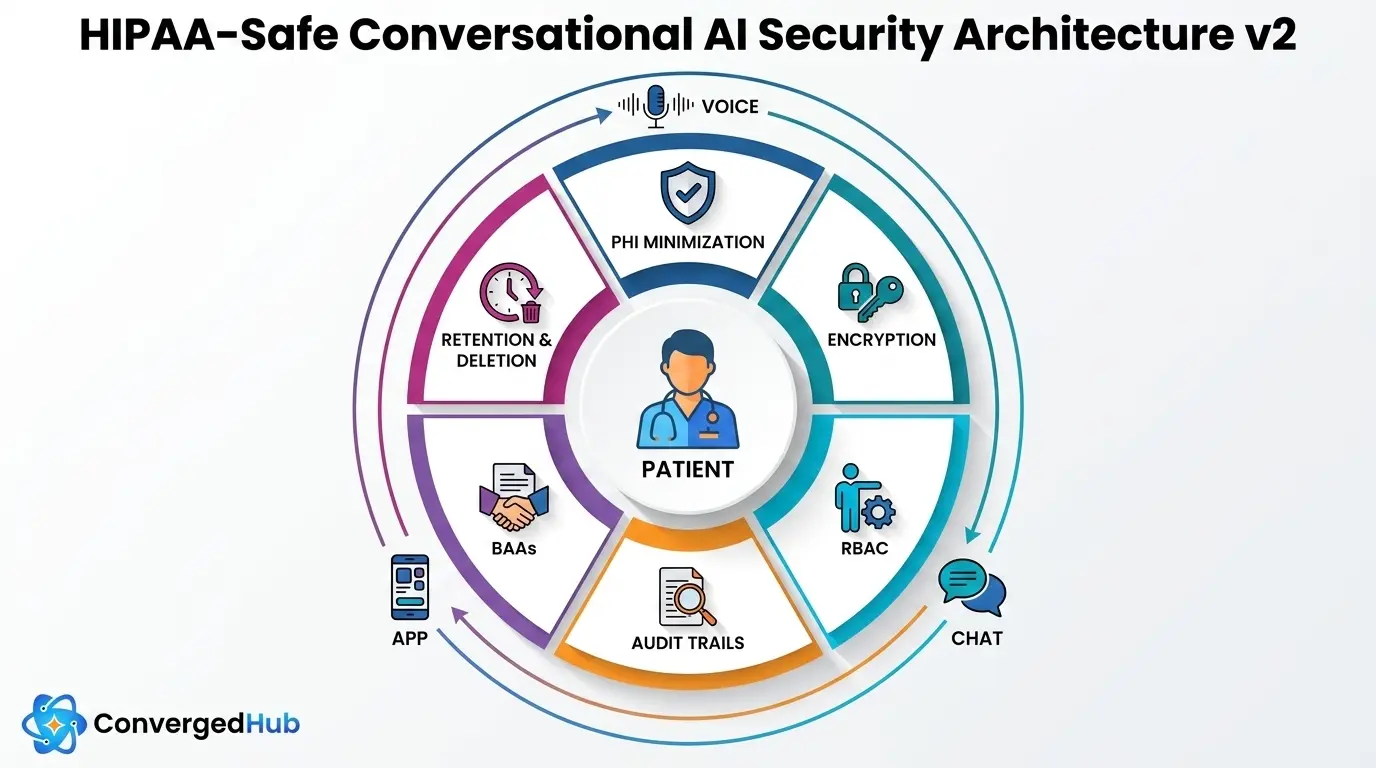
HIPAA compliance is not a checkbox at the end of an AI project; it is an architectural principle. To be truly HIPAA-safe, conversational AI must embed PHI controls in every layer of the stack.
Build PHI handling into the design
- Collect only what you need. Design flows so that identity verification and task completion use the minimum PHI required.
- Mask and redact. Automatically redact identifiers in logs and transcripts, especially in free-text inputs and call recordings.
- Avoid non-compliant services. Do not send PHI to tools that are not under a BAA (for example, public transcription APIs or consumer productivity apps).
Secure data in transit and at rest
- Encryption: Use TLS 1.2+ for data in transit and AES-256 (or equivalent) for data at rest, including recordings and chat histories, in line with the HIPAA Security Rule.
- Segregation: Separate development, test, and production environments. Never use production PHI for training or sandbox testing.
Control access and identity
- RBAC and least privilege: Limit which roles can view raw transcripts or PHI fields.
- SSO/MFA: Enforce strong authentication for agents and administrators.
- Session hygiene: Use strict timeouts and automatic revocation of stale access.
Operational safeguards
- Consent and transparency: Provide clear notices before collecting PHI, honor opt-in for reminders, and make channel preferences easy to manage.
- Audit trails: Maintain tamper-evident logs of who accessed what, when, and why.
- Retention and deletion: Apply policy-driven retention windows, with safe disposal and options to export, purge, or anonymize records.
- BAAs everywhere they belong: Execute and periodically review BAAs for all vendors that touch PHI.
There are platforms that are built with these controls from the ground up give CX teams confidence to innovate without constantly negotiating one-off HIPAA exceptions.
Unified Voice, Chat and Escalation
Patients do not think in channels. They describe symptoms while driving, confirm appointments between meetings, and check bills late at night. HIPAA compliant conversational AI should orchestrate voice, chat, and visual experiences under one policy umbrella.
Voice: secure, natural conversations
On the phone, automatic speech recognition converts speech to text, with on-the-fly redaction of identifiers like full names, dates of birth, or member IDs as needed. Natural language understanding (NLU) interprets intent, validates consent, and performs approved actions such as checking eligibility or booking an appointment.
Every step is wrapped in encryption and access control. Call recordings are stored securely, with limited access, while text-to-speech (TTS) confirms steps in plain language. When conversations veer into clinical territory, escalation rules trigger a warm transfer to a licensed professional.
Chat: web, SMS, and app messaging
In chat, HIPAA compliant conversational AI begins with a short privacy notice and explicit consent. It recognizes intents, retrieves only the minimum PHI needed, and stores redacted transcripts. If patients share images (for example, a wound photo for visual triage), converged voice + visual AI policies govern secure storage, limited access, and timely purging.
Converged orchestration and agent assist
The most advanced deployments use a single orchestration layer so a conversation can move from chat to voice without re-verification. When human handoff is needed, an agent copilot surfaces concise, redacted summaries and recommended next actions, letting clinicians and agents focus on empathy and judgment rather than navigation.
For digital leaders, this converged model means policies are defined once and applied everywhere, rather than reimplemented for each channel or vendor.
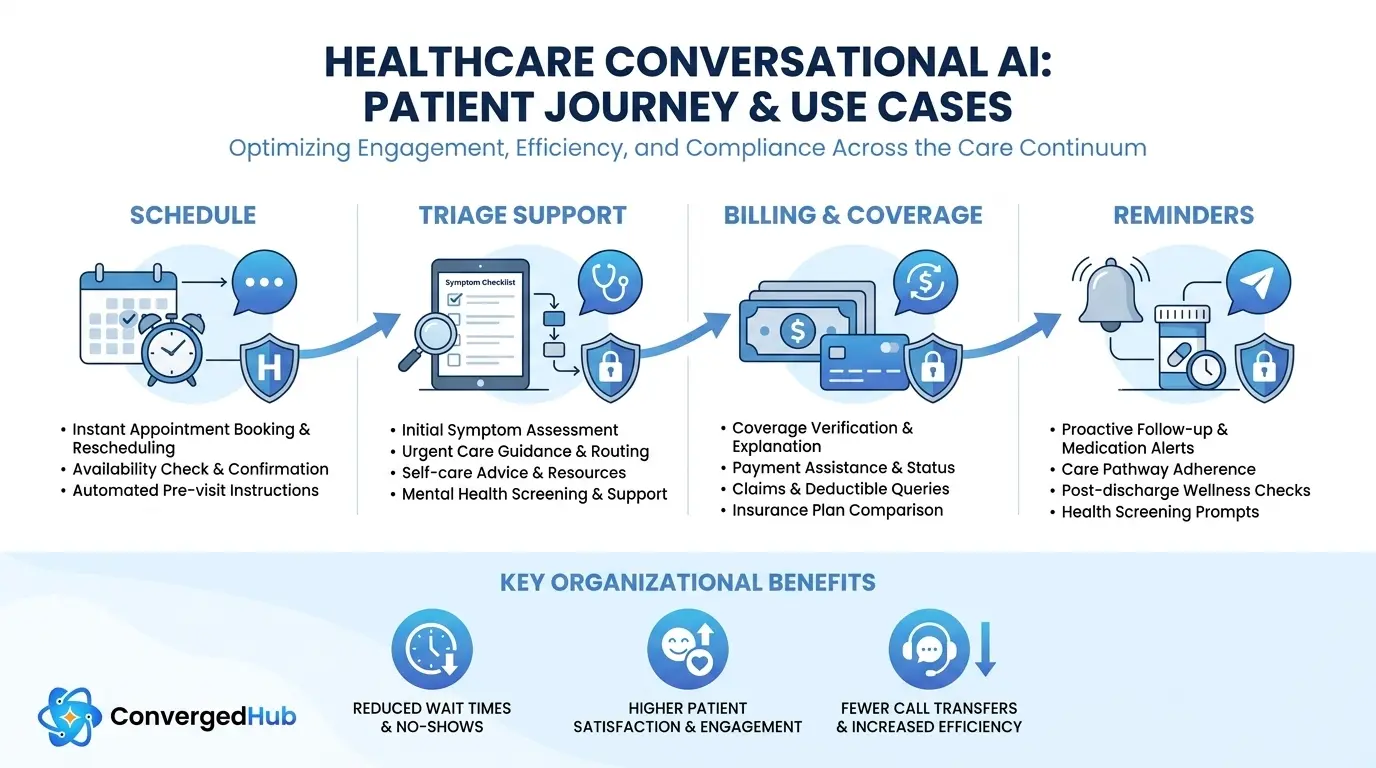
Use Cases You Can Launch Now
Not every interaction should be automated, but many high-volume tasks can be handled safely by HIPAA compliant conversational AI, freeing staff to focus on complex or emotional situations.
- Scheduling and rescheduling: Allow patients to book, confirm, or move appointments via voice or chat with minimal PHI. The assistant verifies identity using non-sensitive factors (for example, phone number plus date of birth), presents available slots, and sends secure confirmations via patient portal, email, or SMS per preference.
- Triage support, not diagnosis: Use AI to collect symptoms using approved clinical protocols and determine whether to route to a nurse line, urgent care, or self-care guidance. Every flow should include clear medical disclaimers and thresholds that instantly escalate to licensed clinicians when risk is detected or the model’s confidence is low.
- Billing and coverage questions: Automate FAQs around statements, copays, prior authorizations, and payment options. For payments, use PCI-validated gateways (see the PCI Security Standards Council) and tokenize card data so it is never stored in conversational logs. This reduces friction for patients while shrinking hold times for your revenue cycle teams.
- Medication and appointment reminders: Send opt-in reminders with limited PHI, such as notifying that an appointment is upcoming without specifying diagnosis. Within the same secure thread, patients can confirm, request refills, or reschedule. Behind the scenes, HIPAA compliant conversational AI logs actions, respects opt-outs, and updates EHR or CRM systems via secure APIs.
Each of these use cases delivers measurable CX benefits today: lower average handle time, higher first-contact resolution, and improved satisfaction scores, without adding compliance risk.
Choosing the Right AI Partner
Evaluating HIPAA compliant conversational AI is about more than a security checklist. CX and digital leaders need a partner that can protect PHI and scale experience innovation.
Key evaluation criteria
- Compliance posture: Documented HIPAA program, BAAs, third-party security assessments, incident response plans, and alignment with frameworks like the NIST AI Risk Management Framework.
- PHI controls: Edge redaction, PHI-only fields, configurable prompts that avoid unnecessary disclosures, and the ability to limit which data elements are ever stored.
- Model governance: Options to disable training on your data, prevent PHI from being used to train external models, and control data residency.
- Channel coverage: Unified policies across phone, web chat, SMS, mobile apps, and visual uploads.
- Experience quality: High ASR accuracy across accents, natural TTS voices, multilingual support, and seamless human handoff.
- Analytics: Conversational insights, deflection analysis, and journey outcomes that exclude raw PHI by default.
Common pitfalls to avoid
- Mixing environments: Using production PHI in dev or analytics sandboxes.
- Leaky tooling: Exporting raw transcripts with PHI to non-compliant BI or ticketing tools.
- Over-collection: Asking for birth dates or member IDs when not actually required.
- Vague consent: Skipping clear opt-in/opt-out flows or burying notices in fine print.
- Shadow AI: Agents pasting PHI into consumer chatbots outside your guardrails.
- Stagnant policies: Letting privacy notices and retention schedules lag behind product changes.
A trust-building patient journey
Consider Maria, 62, who calls after hours about dizziness. The voice assistant opens with a brief privacy notice and asks for consent. It verifies her identity with two non-sensitive factors, then collects symptoms using approved triage prompts. When a medication question exceeds its guardrails, it offers to connect to a nurse line. The nurse receives a concise, redacted summary via agent copilot and resolves the concern. Before ending, the assistant schedules a follow-up and sends an opt-in SMS reminder that omits sensitive details. An audit trail logs every step.
This is what modern healthcare CX looks like when HIPAA compliant conversational AI is designed as a trust engine, not just an automation tool.
Patients notice when access is easy and privacy is respected. HIPAA compliant conversational AI lets you deliver both: faster answers and careful PHI handling across voice, chat, and converged experiences.
Start with a focused set of high-volume use cases like scheduling and billing. Layer in clear consent flows, escalation rules, and robust analytics. As you expand into agent assist and visual AI, keep trust as your north star. The technology is ready; the experience you design around it is what patients will remember.