Your IVR knows your name. Your agents can see your account. And yet your customers still wait in queues, repeat themselves, and get routed through generic menus that ignore everything you already know about them.
In a world trained by Netflix-level relevance and same-day delivery, this gap is no longer tolerable. Voice is often the most emotionally charged channel in your ecosystem, but too many contact centers still treat it as a blind, one-size-fits-all script.
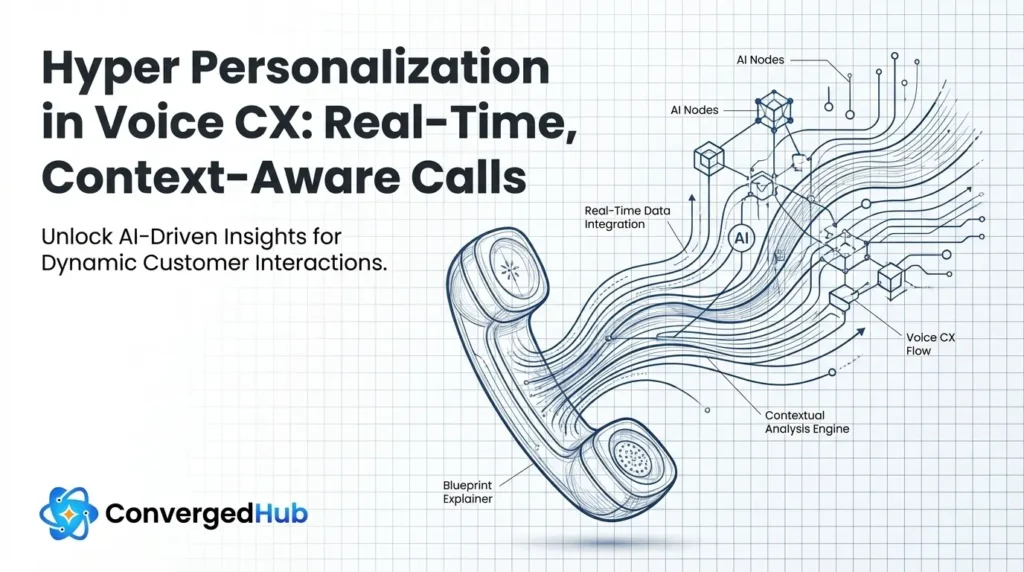
Hyper Personalization in Voice CX changes that. By combining unified customer data, real-time AI, and context-aware conversations, enterprises can transform every call into a turn-by-turn, adaptive experience that feels surprisingly human — even when it is automated.
This article gives CX and Digital Transformation leaders a practical, vendor-neutral playbook to move from basic personalization to real-time voice personalization at scale.
Why Voice CX Must Evolve
The traditional idea of a ‘personalized’ call is shallow: greet by first name, confirm an account number, maybe reference a recent order. Useful, but not enough. It does not reflect why the customer is calling, what they have already tried, or how urgent and emotional the moment is.
Customers now benchmark you against digital-native experiences that anticipate needs and remove friction. Research from McKinsey shows that effective personalization can lift revenues by 5–15% and marketing ROI by 10–30%. When your apps and websites already feel intelligent, static IVR trees and generic agent scripts become painfully obvious.
On a typical call, you already have signals that could power real-time voice personalization:
- Recent digital behavior (web/app journeys, failed self-service)
- Product usage or telemetry (outages, configuration changes, usage spikes)
- Open tickets, orders, billing events, and recent complaints
- Historical sentiment and effort across previous interactions
The problem is not data scarcity; it is orchestration. Without an architecture that fuses these signals and makes real-time decisions, your contact center AI — and your agents — are forced to respond as if every caller is new and unknown.
To meet rising expectations, voice CX must evolve from ‘identify and verify’ to anticipate, adapt, and resolve — within the first seconds of a conversation.
Defining Hyper-Personalized Voice
Hyper Personalization in Voice CX is the discipline of using unified customer data, behavioral insights, AI models, and real-time decisioning to tailor every utterance, prompt, and next-best-action during a call.
It goes far beyond basic personalization:
- Basic personalization: Name, account lookup, generic scripts with minor branching based on a few attributes.
- Hyper personalization: The conversation dynamically adjusts turn-by-turn to the customer’s intent, history, preferences, and live context — including sentiment and behavior on the call itself.
In practice, this means a customer who just tried (and failed) to change their address in your app does not hear a full IVR menu. They are greeted with something like: ‘I see you were updating your address a few minutes ago. Did something go wrong? I can finish that for you now.’ That is context-aware conversation, not just personalization.
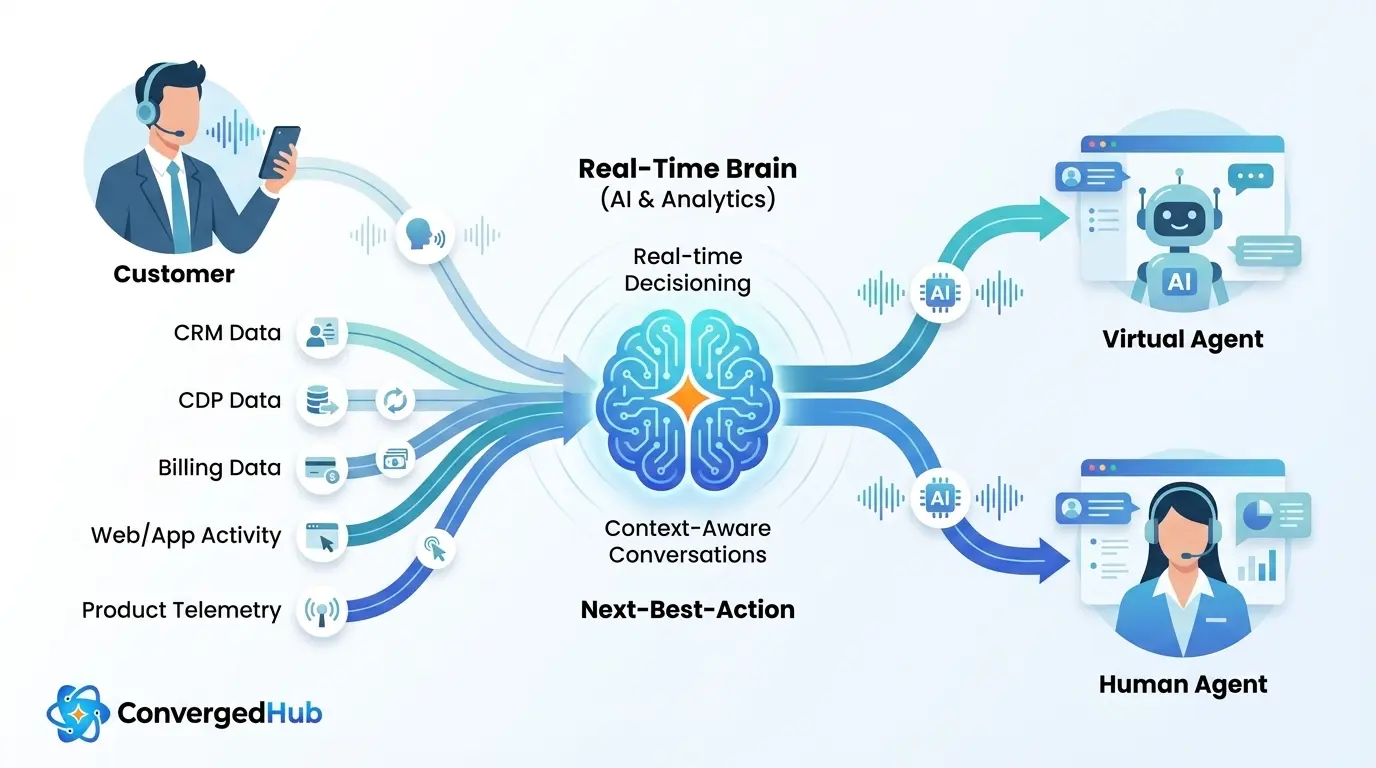
Most enterprise implementations share four core components:
- Data integration: Connecting CRM, CDP, billing, orders, loyalty, telemetry, and IVR logs into a single, trusted view.
- Real-time decisioning: A brain that selects the right next-best-action — resolve, educate, upsell, reassure, or escalate — within milliseconds.
- AI models: Speech, intent, sentiment, and predictive models that interpret what is happening and what is likely to happen next.
- Context management: A memory layer that tracks state across turns, sessions, and channels.
When these pillars come together, voice stops being a static script and becomes a living, adaptive experience.
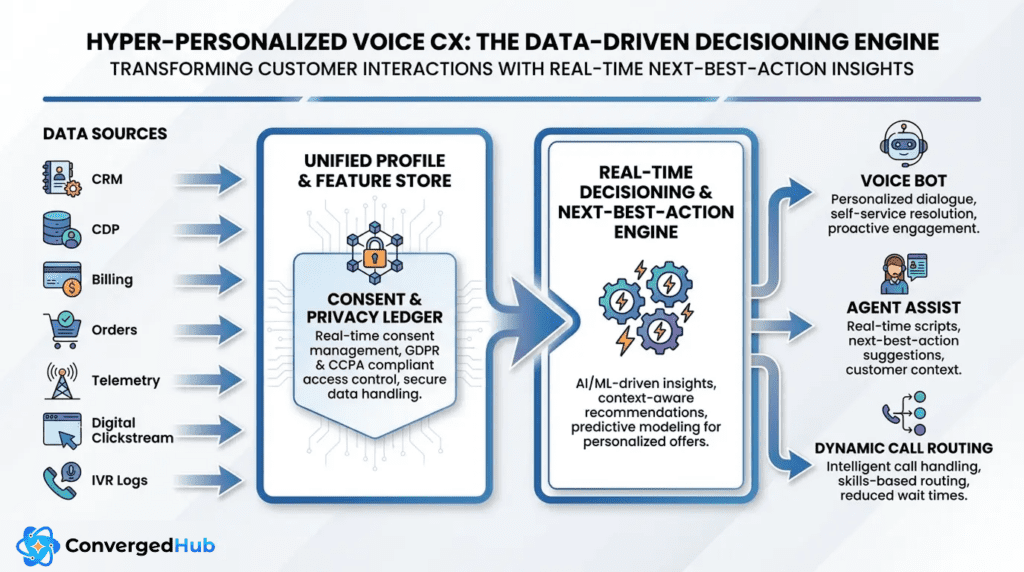
Data & Decisioning Backbone
Hyper personalization lives or dies on the quality and availability of data. For voice CX, the goal is to build a low-latency, governed data and decisioning backbone that can feed both bots and human agents in real time.
Unifying customer data for voice
Start with a robust profile that stitches together signals from:
- CRM (accounts, cases, opportunities)
- Customer Data Platform (CDP) for behavioral and preference data — see Gartner’s definition of a CDP here
- Billing and collections (payments, dunning status, disputes)
- Orders and subscriptions (renewal dates, add-ons, cancellations)
- Product usage/telemetry (outages, device data, feature adoption)
- Digital clickstream (web/app journeys, search terms, self-service flows)
- IVR/ACD logs (previous call reasons, transfers, handle time)
Use identity resolution to match records to the caller in real time (phone, account, device, or authenticated ID). A dedicated feature store can expose key attributes and signals with low latency for both models and rules engines, while a consent and privacy ledger tracks what you are allowed to use for each customer.
Real-time decisioning and next-best-action
On top of this data foundation, you need a decision layer that can pick the right next-best-action mid-conversation. This typically includes:
- Business rules and policies (eligibility, compliance, brand tone)
- Scoring models (churn risk, propensity to buy, likelihood to pay)
- Multi-armed bandits or reinforcement learning to learn which offers, flows, or responses perform best over time
- Deterministic guardrails that override models when regulation or ethics require hard constraints
The decision engine must respond within strict latency budgets — typically under 200–300ms — so the caller never feels lag. This backbone is what turns a customer data platform for voice into a true customer journey orchestration engine for your contact center.
AI, Context, and Turn-by-Turn
Once the data and decisioning layers are in place, AI models and context management bring real-time voice personalization to life at the level of each spoken turn.
AI models powering context-aware conversations
Key capabilities include:
- Speech recognition and TTS, tuned for your domain, accents, and noise patterns.
- Intent detection to infer why the customer is calling, even if they do not use your menu language.
- Sentiment and emotion analysis to detect frustration, confusion, or relief.
- Topic and entity extraction to capture products, locations, dates, and dollar amounts mentioned.
- Predictive models for churn, lifetime value, credit risk, and likelihood to respond to specific interventions.
Foundational resources like IBM’s overview of natural language processing are useful starting points for your data science teams, but the real value comes from domain-specific tuning.
Context management and dynamic adaptation
Hyper personalization requires a strong notion of context, including:
- Session memory: What was said earlier in this call, including failed attempts and clarifications.
- Cross-channel history: Recent app, web, email, and chat interactions that led to the call.
- Environment and device: Mobile vs. landline, app-initiated calls, location or time-of-day cues.
- Customer state: New vs. existing, VIP status, open cases, scheduled deliveries or visits.
- Escalation context: What the bot attempted, what worked, and what did not — passed seamlessly to a human agent.
With this context, your system can adapt turn-by-turn:
- Adjusting explanation depth based on interruptions or signs of confusion.
- Modifying speaking rate and formality to match caller behavior and preferences.
- Handling ambiguity gracefully with targeted clarifying questions instead of generic ‘I did not catch that.’
- Triggering dynamic call routing to the right specialist when sentiment and complexity cross thresholds — with full context on the agent’s screen.
The result is a conversation that feels more like a skilled human who remembers you and less like a rigid machine.
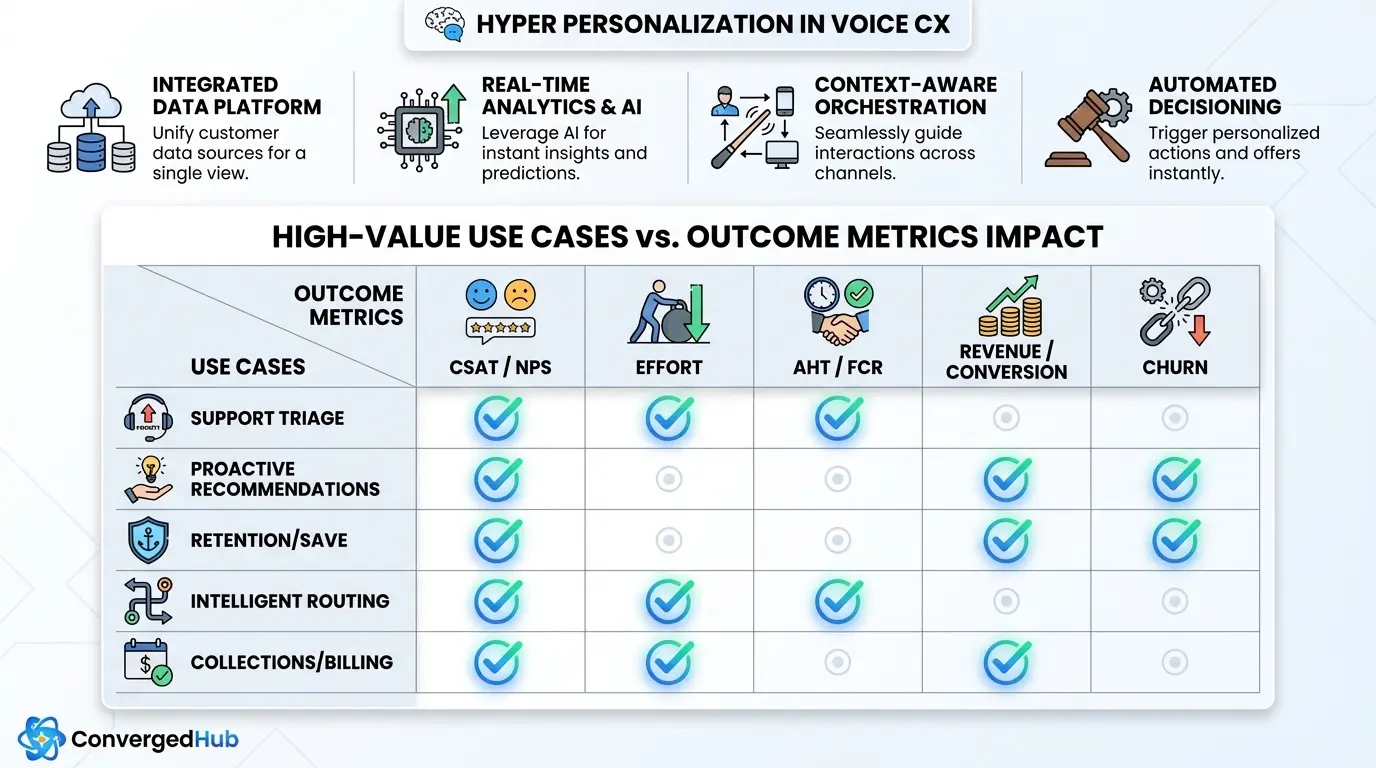
Use Cases & Outcome Metrics
For enterprise leaders, Hyper Personalization in Voice CX must translate into tangible impact. The most powerful use cases pair clear customer value with measurable business outcomes.
High-value use cases
- Personalized support triage: Use intent detection, recent digital behavior, and device data to fast-track common issues (e.g., known outage in customer’s area) and bypass generic menus.
- Proactive recommendations in-call: During troubleshooting, surface contextual next-best-actions such as enabling a feature the customer is eligible for or scheduling a callback instead of queueing.
- Retention and save conversations: When cancellation intent is detected and churn risk is high, dynamically adjust offers, messaging, and empathy-led scripting based on tenure, value, and previous issues.
- Intelligent routing and agent fit: Combine skill-based routing with predicted effort, sentiment history, and language preference to match the caller to the agent most likely to succeed.
- Eligibility-aware billing and collections: Adapt tone and options (payment plans, extensions) based on risk scores, compliance rules, and prior payment behavior to reduce friction and complaints.
Measuring impact where it matters
Build a KPI tree that connects personalization to outcomes both customers and executives care about:
- Experience metrics: CSAT, NPS, and Customer Effort Score, with cuts by call type and segment.
- Operational metrics: Average Handle Time (AHT), First-Contact Resolution (FCR), transfer rate, and containment for automated experiences.
- Revenue metrics: Conversion and upsell on eligibility-aware offers, renewal rates, and average order value when agents or bots suggest next-best-actions.
- Retention metrics: Churn, save rates in retention queues, and complaint volumes.
Hyper-personalized voice journeys should be instrumented end-to-end: from decision logs and model outputs to downstream outcomes in your analytics or lakehouse environment. That instrumentation is essential for continuous optimization and for proving ROI to the C-suite.
Governance & 90-Day Playbook
Hyper personalization touches sensitive data, high-stakes conversations, and automated decisioning — a potent mix that demands robust governance and a pragmatic delivery plan.
Risk, governance, and the creepy line
Key guardrails to establish early:
- Data privacy and consent: Align with frameworks such as the NIST AI Risk Management Framework. Limit use of highly sensitive attributes unless clearly beneficial and consented.
- Data minimization and retention: Store only what you need for defined use cases. Set retention windows for call recordings, transcripts, and derived features.
- Bias and fairness: Monitor models for disparate impact across demographic or vulnerable segments. Provide override mechanisms when automated decisions conflict with fairness principles.
- Transparency and preference control: Avoid crossing the ‘creepy line’ — offer simple explanations (‘I can see your recent order’) and easy ways to adjust personalization settings.
- Operational resilience: Design for latency SLAs, failover paths (e.g., from AI to simplified IVR or agent), redaction of PII, and full observability of model decisions.
A 90-day execution roadmap
To move from vision to reality, use a staged approach:
- Days 0–30: Discover and define
- Select 1–2 high-volume, high-friction call types (e.g., billing questions, order status, password reset).
- Map current journeys, including digital touchpoints leading to the call.
- Define success metrics (FCR, AHT, CSAT, containment) and customer safeguards.
- Inventory data sources; establish the minimal customer data platform for voice profile needed for these journeys.
- Days 31–60: Build and pilot
- Implement real-time data access for the selected journeys (e.g., recent orders, tickets, digital attempts).
- Configure a simple next-best-action policy layer with clear guardrails.
- Deploy an AI-powered voice experience (bot-assisted or agent-assist) that uses context-aware conversations and cross-channel memory.
- Run controlled A/B tests against your existing IVR or scripts.
- Days 61–90: Measure and scale
- Analyze impact on KPIs and customer feedback; refine models and rules.
- Extend to additional intents and journeys; add more data features where ROI is proven.
- Formalize an operating model that unites CX, Data, and Engineering teams with shared playbooks, ModelOps practices, and continuous QA/compliance monitoring.
Alongside this roadmap, invest in a reference architecture that connects CRM and CDP, your voice AI/telephony stack (ASR/TTS/NLU, IVR/ACD), journey orchestration layer, QA/compliance tools, and analytics or lakehouse platforms. With the right foundations, you can scale Hyper Personalization in Voice CX from a pilot to an enterprise-wide capability.
Hyper Personalization in Voice CX is not about dazzling customers with gimmicks. It is about removing friction, anticipating needs, and making every second of a call count.
For CX and Digital Transformation leaders, the opportunity is clear: treat voice as a data-rich, AI-driven channel instead of an isolated script. Build a unified profile, deploy real-time decisioning, govern it rigorously, and start with a focused 90-day push on a few critical journeys.
Done well, real-time voice personalization turns contact centers from cost centers into intelligent, memory-driven relationship engines — and makes every conversation feel like it was designed for exactly one person: the caller.